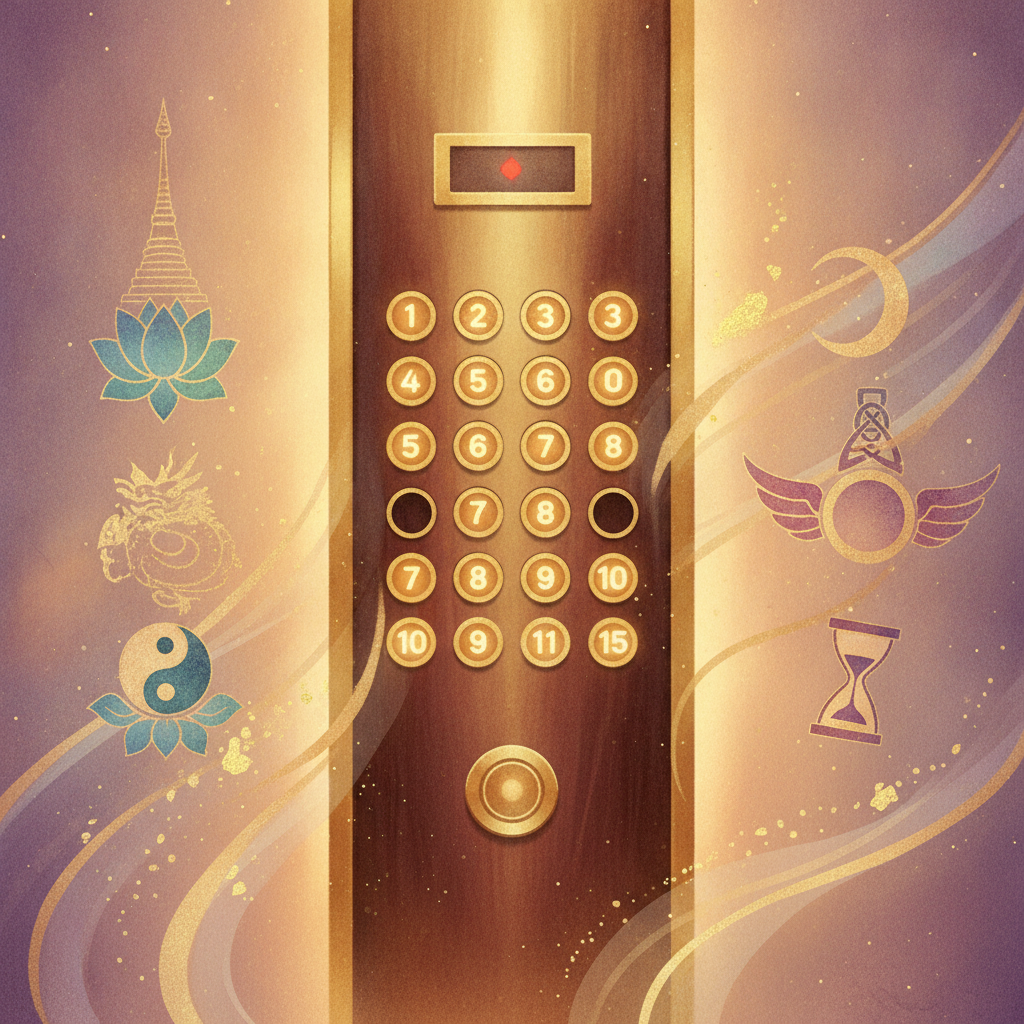
Many people may have noticed that in some tall buildings, when entering an elevator and looking at the floor buttons, certain floor numbers are missing—particularly the number 13 in Western countries or the number 4 in Asian countries. This reflects the belief in "unlucky numbers" that are deeply rooted in various cultures and have actually influenced building design.
The Fear of Number 13 in the Western World
According to Western cultural beliefs, the number 13 is considered one of the most unlucky numbers. There is even a specific term for the fear of the number 13: "Triskaidekaphobia." The origins of this belief are varied. Some legends reference the Biblical account of Jesus's last supper, which had 13 attendees, with the 13th person being Judas the traitor. In ancient Norse mythology, there is a tale of a banquet of the gods with 12 deities, but Loki, the god of chaos, arrived as the 13th guest and caused disaster.
This belief spread so widely that many hotels, office buildings, and condominiums in America, Europe, and Australia chose to skip the number 13 entirely, jumping from floor 12 directly to floor 14, or using 12A instead. Some airlines also do not have rows numbered 13.
The Unlucky Number 4 in East Asia
In China, Japan, Korea, and Taiwan, the number 4 is the numeral most commonly avoided. This is because the pronunciation of "four" in Mandarin (四 - sì) and Japanese (四 - shi) sounds nearly identical to the word for "death" (死), creating a belief that the number 4 brings death and misfortune.
For this reason, buildings in these countries often skip floors 4, 14, 24, 34, 44, and other floors containing the digit 4. Some tall buildings in Hong Kong and Singapore may skip dozens of floors altogether. Many hospitals in Japan do not have rooms numbered 4, and gifts in sets of four are considered inappropriate.
Other Unlucky Numbers Around the World
There are other numbers avoided in certain cultures, such as the number 17 in Italy. When written as the Roman numeral XVII and the letters are rearranged, it becomes VIXI, which translates to "I have lived" or "I am dead" in Latin. In some parts of China, the number 7 is also viewed unfavorably because the seventh month is considered the month of ghosts.
Interestingly, in some countries both 4 and 13 are avoided together, such as in Singapore and Malaysia, which have both Chinese and Western residents. This causes some buildings to skip both numbers to accommodate the beliefs of all communities.
Astrological and Belief Perspectives
In Thai astrology, the selection of auspicious numbers or avoidance of unlucky numbers has existed since ancient times, based on principles of auspicious timing, planetary calculations, and numerology according to Hindu astrological tradition. However, whether a number is considered good or bad depends on context and the individual's destiny, and is not absolute like the belief in the numbers 4 or 13 in other cultures.
Experts in belief systems often explain that the avoidance of these unlucky numbers reflects the power of the human mind and respect for tradition more than anything truly supernatural. Yet when beliefs become deeply rooted and part of a culture, real estate developers choose to adapt in order to preserve property values and the comfort of residents.
Whether one believes or not, the stories of these unlucky numbers are part of an interesting cultural heritage and continue to influence how people live in many societies today. Next time you enter an elevator, observe which floor the building skips—it may tell you in which culture it was built or which demographic it primarily serves.
Compiled from publicly released news · Source: Sanook