Among the deities that Thai people favor worshiping and seeking blessings from, Ganesha, who removes obstacles and resolves problems, is one of the most visited. Yet few know how deeply this belief is rooted in legend and Ganesha's status in Hindu-Brahmanical scriptures. This article will introduce you to Ganesha through documented stories so you can understand why people turn to him first when life becomes difficult.
The Legend of Ganesha: From Elephant Head to Lord of Obstacles
First, let us briefly address Ganesha's origin and the breaking of his tusk, as these two matters contain interesting details that vary across different texts. According to the Shiva Purana, Mother Parvati molded a young boy from clay and assigned him to guard the door. When Shiva returned and did not recognize the boy, a battle ensued in which the boy's head was severed. Later, an elephant's head was attached to restore him to life. The Brahma Vaivarta Purana, however, tells a different story—that the head was lost due to Shani's gaze, not from combat. These two versions are distinct narratives and should not be conflated. As for the accounts of Ganesha's role in the Mahabharata and the breaking of his tusk, there are details worth exploring further and can be read in the articles The Birth of Ganesha and Ganesha and the Mahabharata
This article emphasizes another legend that is widely known and most clearly reflects Ganesha's character: the story of the race around the world against Kartikeya.
The Race Around the World: Wisdom Triumphs Over Strength
According to a story common in Hindu culture (though no clear scriptural source has been identified), Shiva and Parvati once held a competition between their two sons, Ganesha and Kartikeya, declaring that whoever could circumambulate the three worlds first would receive a special reward.
Kartikeya possessed a peacock as his vehicle, which was swift, so he set out to circumambulate the world immediately. Ganesha had only a mouse as his vehicle, which seemed clearly disadvantageous. Yet rather than rush to catch up, Ganesha remained still and contemplated. He then circumambulated Shiva and Parvati three times, and reverently declared: "Father and Mother are the three worlds. Whoever worships their parents receives the benefit of circumambulating all the worlds."
When Kartikeya returned from his long journey, Shiva and Parvati confirmed that Ganesha had won the race through wisdom and gratitude, not through speed or strength.
This story has multiple layers of significance. The first reflects Ganesha's character—using thought to solve problems rather than competing through brute force. The second demonstrates that filial gratitude holds the highest value in Hindu worldview. The third, which is spiritually crucial, is that Ganesha remains "close" to Shiva and Parvati always, which naturally makes him a mediator between humans and the supreme deity.
It should be noted that different regions of India hold different beliefs about the seniority of the two sons. Northern India considers Kartikeya the elder, while southern India considers Ganesha the elder. This variation reflects the regional diversity of Hindu legend—there is no single "correct" version.
Vighnesvara: Master of All Obstacles
Beyond the legends, Ganesha's status in Hindu scriptures is crucial to understanding why people seek his blessings for obstacles. In Hindu texts, Ganesha is honored with the title Vighnesvara or Vighnraj, which means "Lord of Obstacles" or "Lord of Vighna."
Interestingly, this status has two dimensions that seem contradictory but are actually one and the same. The first is that he is the Remover of Obstacles for those worthy of success. The second is that he is the Placer of Obstacles for those who should be hindered. Together, these two dimensions show that Ganesha is the controller of the currents of fate and success, not merely a one-sided blessing deity.
For this reason, in traditional Hindu practice, Ganesha must be worshiped before any ritual, before a journey, before starting a business, or before any important undertaking, to ask him to open the way and remove impediments. In Hindu-Brahmanical belief, beginning without first worshiping Ganesha is considered an oversight that may cause the work to be hindered.
In Thailand, Ganesha is also honored as the deity of arts and sciences, as evidenced by the Department of Fine Arts using an image of Ganesha as its emblem. This reflects how the belief in Ganesha in Thai context blends traditional Hindu-Brahmanical doctrine with local cultural elements, creating a unique identity.
Ganesha's Personality and Character Reflected in Legend
Reading Ganesha's various legends together reveals a personality that is distinctive and remarkably consistent.
Wisdom Over Strength: In both the race around the world and other tales, Ganesha consistently demonstrates that he chooses to think before acting. Rather than competing through speed or power, he pauses to devise a cleverer solution, achieving better results with less effort.
Gratitude and Respect for Parents: The story of circumambulating his father and mother instead of the world reflects the value Ganesha holds: placing the highest importance on parents. In Hindu worldview, parents are the deities closest to their children.
The Deity of Beginnings: As Vighnesvara, Ganesha must be worshiped before all things, making him the representative of a good beginning, the door opening to success.
The Lord of Arts and Knowledge: In Hindu scriptures, Ganesha is connected to writing, language, art, and knowledge—all requiring both wisdom and creative thought. This characteristic aligns with his nature of using intellect to solve problems seen in the legends.
Controller of the Currents of Destiny: His role as both remover and placer of obstacles shows that Ganesha is not a deity who "gives everything," but one who maintains justice by opening and closing paths. This quality makes worshiping him more weighty and meaningful than seeking blessings from ordinary deities.
Why People Commonly Seek Blessings for Obstacles, Studies, and Work
Once the legends and personality of Ganesha are understood, the reasons why people seek his blessings for various matters become clearer. According to Hindu-Brahmanical belief and common Thai practice, Ganesha is the refuge in these matters for reasons directly connected to the legends.
Seeking blessings to solve and remove problems and obstacles is the most common request and directly connects to Vighnesvara's status in Hindu scriptures. Since Ganesha controls all obstacles, asking him to open the way aligns precisely with his function—not a fabricated belief, but one rooted in scripture.
Seeking blessings for new beginnings, whether opening a business, starting a new job, moving house, or beginning life in a new chapter, connects to Ganesha's status as the deity of beginnings in Hindu tradition, which prescribes worshiping him before all rituals and undertakings. According to this belief, a good beginning requires Ganesha to open the way.
Seeking blessings for studies and exams links to Ganesha's character as the deity of wisdom, art, and knowledge. According to widespread Thai belief, Ganesha is the deity of arts and sciences, as seen in the Department of Fine Arts emblem. Students and undergraduates thus commonly seek his blessings before exams or before beginning studies at a new level.
Seeking blessings for work and success connects both to Vighnesvara's status and to his character of using wisdom to solve problems. According to the belief, Ganesha opens the path to success and removes impediments, allowing work to proceed smoothly.
Notably, the legend of the race around the world beautifully reflects the essence of all these blessings. Ganesha does not use force but employs wisdom to find a better solution. Those seeking blessings for problems and obstacles hope for exactly this: to gain wisdom and a better solution than facing difficulties through strength alone.
The belief in seeking Ganesha's blessings is rooted in Hindu-Brahmanical tradition, which entered Thailand and blended with local belief systems, becoming part of contemporary Thai culture. Those who practice Buddhism can also worship Ganesha according to their faith, without necessarily conflicting with other beliefs, as in the Thai context, multiple belief systems coexist harmoniously.
Where to Worship Ganesha
For those who wish to pay respects to Ganesha in person, there are several significant locations throughout the country. Three renowned and distinctly characterized locations are recommended.
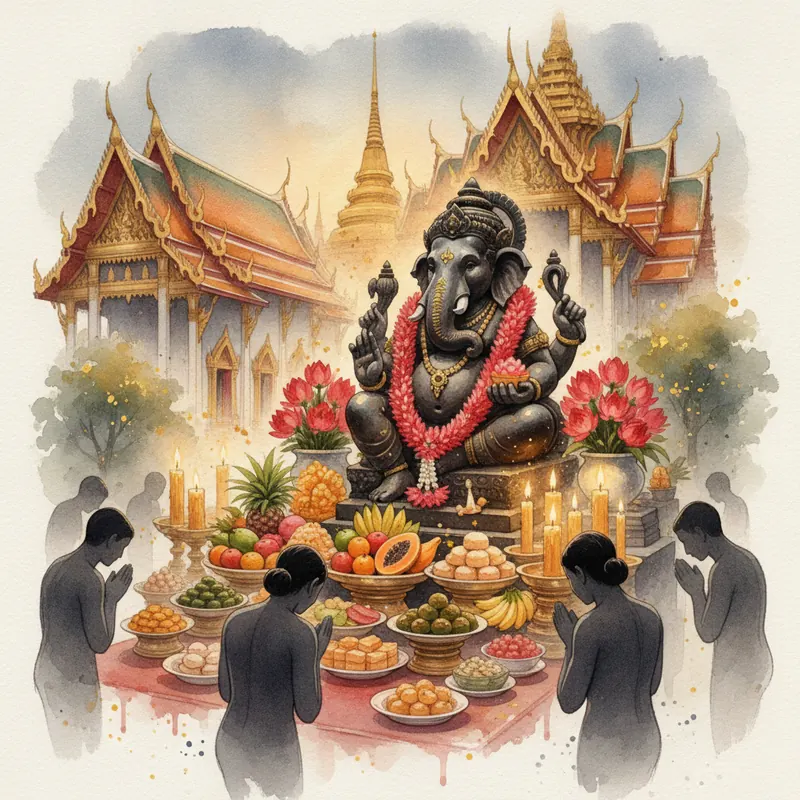
Ganesha Shrine, Ratchda-Huai Khwang Intersection (Bangkok) is a popular Ganesha shrine in Bangkok. According to those who worship there, people commonly seek blessings for work, studies, exams, and success. There are shops selling offerings in front of the shrine. Popular offerings, according to available information, include bananas, sugarcane, pineapple, sweets, fresh milk, red water, silk scarves, and candles.
Brahmin Temple (Bangkok) is an ancient shrine with a long history. Following Brahminical custom, Ganesha is worshiped first before any other deity. People seek blessings for work, studies, and success. There are shops selling offerings within the temple.
Ganesha Park, Nakhon Nayok (Nakhon Nayok) is a special location housing 108 forms of Ganesha, each with its own unique meaning and belief. It is suitable for those wishing to learn the diversity of Ganesha from various perspectives and to seek blessings according to the meaning of each form.
Beyond these three, there are many other places to worship Ganesha throughout the country. You can search at Find Ganesha worship sites nationwide
Worship Methods According to Belief
Regarding offerings to Ganesha, the information with clear sources in this article includes the popular offerings at Ganesha Shrine, Ratchda-Huai Khwang Intersection: bananas, sugarcane, pineapple, sweets, fresh milk, red water, silk scarves, and candles. Other locations have shops selling offerings in their areas, which are convenient and typically aligned with that location's customs.
As for specific prohibitions, incantations, directions to face, or auspicious times for worshiping Ganesha, no standardized text has been found. Different temples or shrines may have their own customs, so it is best to ask the staff at that location directly.
A general principle applicable to worshiping all sacred places is to worship with a calm and steadfast mind, dress appropriately for the setting, and respect that location's customs—a basic courtesy more important than expensive offerings or complicated rituals.
For those interested in the festival of worshiping the Mother Goddess in Hindu belief, which is related, more can be read at Navaratri: The 9 Sacred Nights of Worshiping the Mother Goddess in Hindu Belief
Frequently Asked Questions
Are Ganesha and Kanesha the same deity?
Yes, they are the same. Ganesha has many names in different languages, including Ganesha, Ganesh, Kanesh, Ganapati, and in Sanskrit "Ganesha"—all refer to the same deity with an elephant head who is the son of Shiva and Parvati in Hindu-Brahmanical belief.
What is Ganesha the deity of?
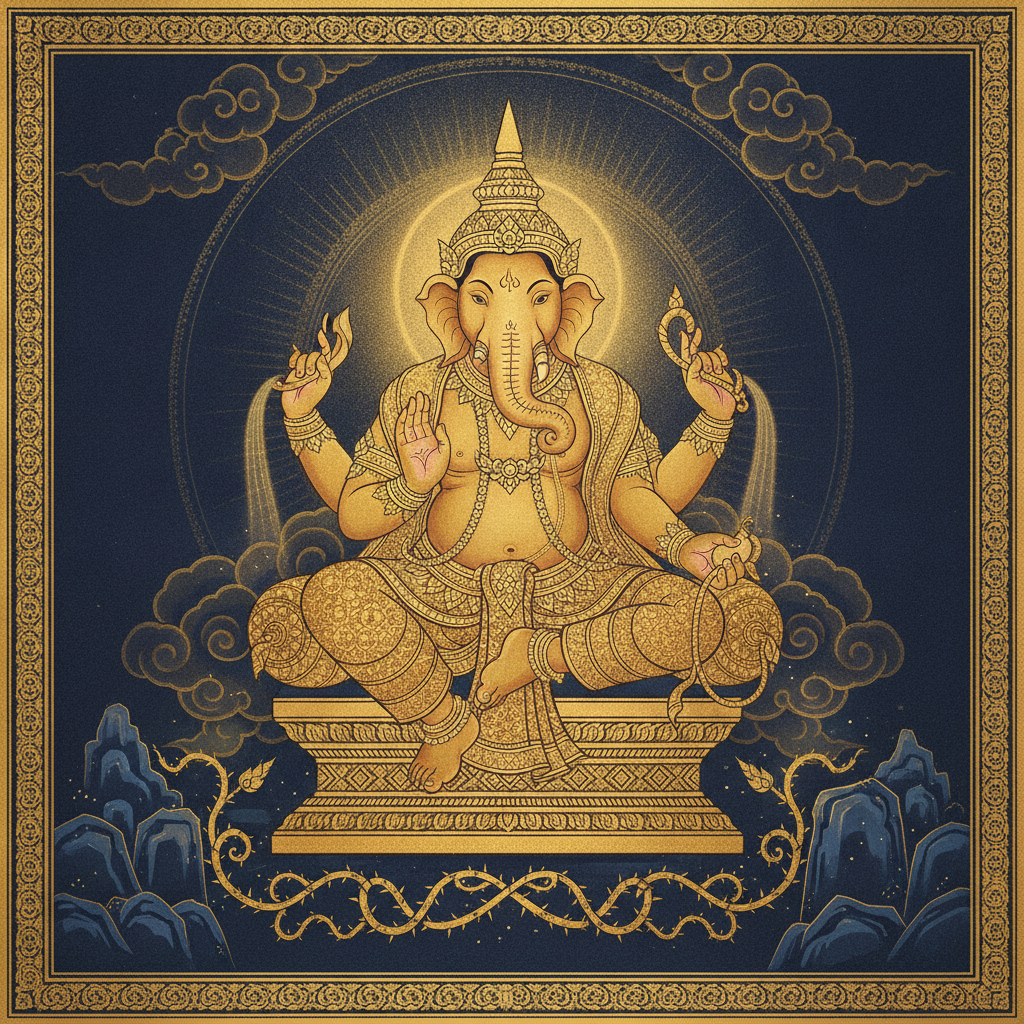
According to Hindu scriptures and widespread belief, Ganesha is the deity of beginnings, the deity of obstacles (both remover and placer), the deity of wisdom, the deity of art and knowledge. In the Thai context, he is also considered the deity of arts and sciences, as reflected in the Department of Fine Arts emblem.
Why must Ganesha be worshiped before other deities?
According to Hindu-Brahmanical custom, Ganesha must be worshiped before any ritual and undertaking because he is the deity of beginnings and has power over obstacles. This belief holds that worshiping Ganesha first is a request for him to open the way and remove impediments before starting anything.
Ganesha's legend exists in many versions—which is correct?
Hindu legends naturally have multiple versions told differently across scriptures and regions. For example, the story of Ganesha's elephant head differs between the Shiva Purana and Brahma Vaivarta Purana. The seniority between Ganesha and Kartikeya varies by region. This diversity is normal in Hindu scriptures—no single version is "correct" for all sects and regions.
Ganesha is a multi-layered deity in legend, character, and scriptural status. Understanding the origins of this belief gives worship greater meaning. Whatever blessing you seek, the essential element is sincere intention and respect from the heart. If you wish to know which deity is particularly suited to your destiny, try asking Nong Lekha which deity you should worship to align with your destiny or see the auspicious calendar that tells which days are suitable for worship and auspicious wallpapers of Ganesha for those who wish to carry their faith with them.
References
- Wikipedia: Ganesha — https://en.wikipedia.org/wiki/Ganesha
- Wikipedia: Mythological anecdotes of Ganesha (citing Shiva Purana IV.17.47-57 / Brahma Vaivarta Purana) — https://en.wikipedia.org/wiki/Mythological_anecdotes_of_Ganesha
- Information on popularity of seeking Ganesha's blessings — https://travel.trueid.net/detail/azQdqv9ZL4jA
- Shiva Purana
- Brahma Vaivarta Purana