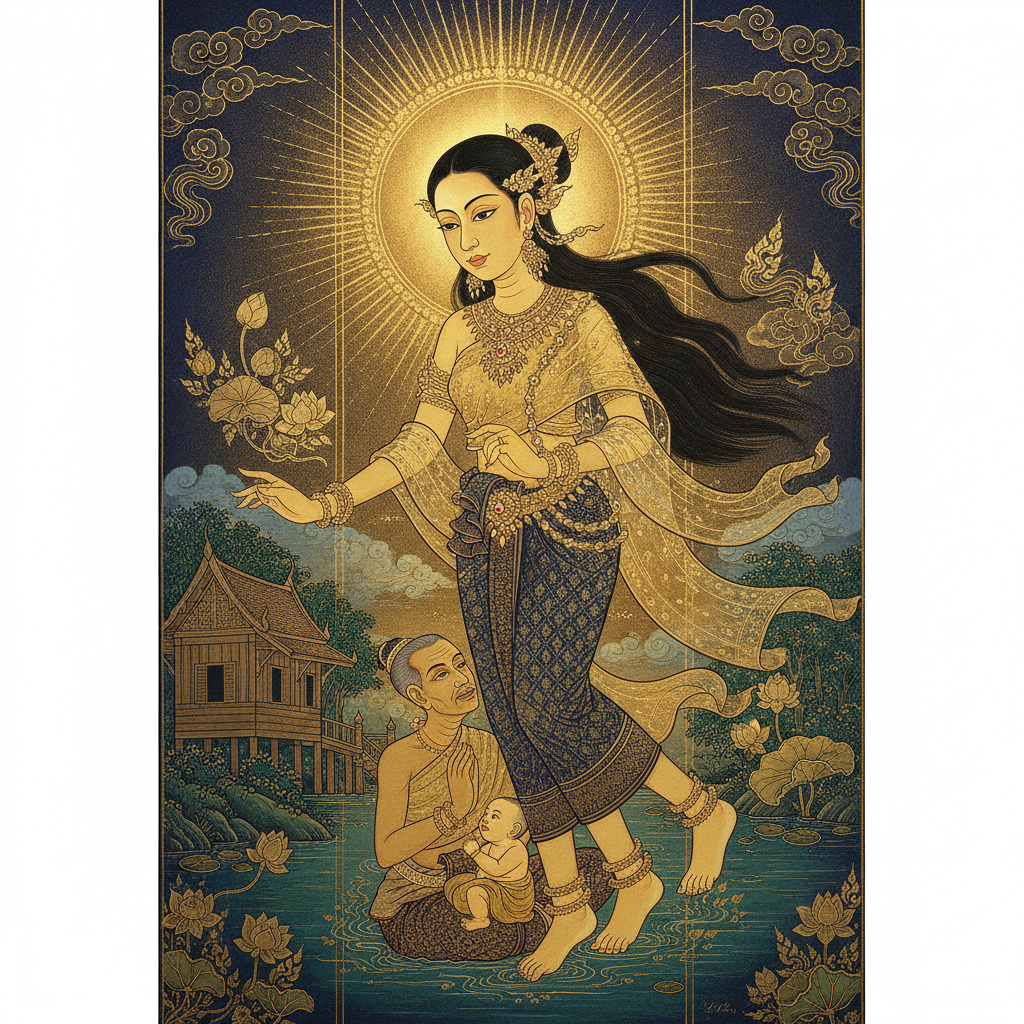
When speaking of Mae Nak Phra Khanong legend, Thailand's immortal tale of love, nearly everyone recalls the image of a young woman by Phra Khanong Canal waiting for her husband with a heart that would not let go even in death. This story has taken deep root in Thai culture for many generations, and devotees continue to make pilgrimages to pay respects and seek blessings at Wat Mahabut without pause.
The Legend of Mae Nak Phra Khanong: Multiple Versions Along the Canal
The Mae Nak Phra Khanong legend is set during the reign of King Rama IV of the Rattanakosin period, in the Phra Khanong Canal area which was then a quiet riverside community. According to popular accounts, Nang Nak was a young woman happily married and living with her husband, before life took a turn when her husband had to leave to become a soldier.
While her husband was away, Nang Nak became pregnant and went into labor. But that childbirth was fraught with danger. According to folk accounts, Nang Nak died along with the unborn child while her husband remained in the battlefield. Yet her spirit would not depart. Bound by love and attachment to her husband and child, she remained in the house by Phra Khanong Canal as though everything were normal.
When her husband returned from the war, he came back to find her and lived with her without knowing the truth. The villagers knew well that Nang Nak had died, but none dared tell him out of fear. Until finally her husband learned the truth. According to most popular accounts, he fled to take refuge at Wat Mahabut, which was not far away.
The ending of the legend has several different versions, and none can be firmly established as the "official" one, including:
- The Version of Sealed in an Urn Weighted with Water: According to one account, Nang Nak's spirit was confined in an earthen vessel and weighted down into the canal so that her soul would become still and no longer wander.
- The Version Bound with the Monk's Waist Cord: Another account tells of a monk who used his waist cord (the sash worn by monks) to bind Nang Nak's spirit so that she could no longer cause trouble.
- The Version of Being Persuaded to Await the Next Life: Yet another account says that a monk persuaded her through the Dhamma to accept the truth and willingly release her worldly attachments, so as to be reunited with her husband in the next life.
What all versions have in common is the heart of the story: Nang Nak's profound love for her husband and child, which kept her spirit wandering in the human world.
Historical Sources: Kromma Atchayan Kularab and Siam Samurai Newspaper
Historian Anukit Nawikamul researched the origins of this legend and found that the oldest traceable evidence dates back to an article in the newspaper Siam Samurai from B.E. 2442 (1899). The article was written by Kromma Atchayan Kularab, a famous writer and newspaperman of that era.
Interestingly, in Kromma Atchayan Kularab's version, the name of Nang Nak's husband was not "Nai Mak" as most people know it, but rather "Nai Chum", and the woman at the center of the story was named "Am Daeng Nak". Kromma Atchayan Kularab claimed that such a person actually existed in history.
However, it should be understood that the article in Siam Samurai was a recording of folk accounts that Kromma Atchayan Kularab had collected, not an official government document or legal evidence. The fact that place names and people appear in the article makes this legend more interestingly grounded than typical folk tales, yet it still cannot be fully confirmed that all events occurred exactly as told.
Because this legend contains both elements of folk narrative and traces of history that can be traced, Mae Nak Phra Khanong has become one of the most studied legends in Thai culture, and has been adapted into countless films, plays, and literary works over the decades.
What Is the Belief System Based On?
The framework of belief regarding Mae Nak Phra Khanong blends two streams: folk beliefs about ghosts and spirits, which form the original foundation of the tale, and Buddhism, which became involved through the roles of monks in controlling or appeasing spirits in the legend, as well as the fact that Mae Nak's shrine is located within a temple. These two streams blend harmoniously in the Thai manner of belief, which typically does not separate them.
The Personality and Character of Mae Nak Phra Khanong as Reflected in the Legend
Throughout every version of the legend, the personality consistently shown is love and loyalty to family. She is a devoted wife who waits for her husband with a steadfast heart, even facing the pain of childbirth without her husband at her side.
According to the tale, Nang Nak was not a spirit intent on harming others without cause. What drove her to remain wandering in the human world was her profound love for her husband and child—not anger or vengeance. She simply wished to remain with those she loved, a fundamental human desire that everyone can understand.
This attachment itself makes Mae Nak Phra Khanong different from ghosts in other cultures. Many devotees view her as a representative of pure maternal love and wifely love that is greater than death.
In terms of folk belief, she is seen as understanding the suffering of women who must bear burdens alone—whether bearing and delivering a child without a husband at her side, or waiting for a beloved who must leave for social duty. These understandings make devotees, mostly women, feel that she is someone who will truly listen to and understand their pain.
Why Is It Common to Ask for Blessings Regarding Childbirth and Military Conscription?
According to devotee beliefs, prayers to Mae Nak Phra Khanong often relate directly to events connected with her fate in the legend. These can be divided into two main categories:
Childbirth and the Safety of Mother and Child
According to the tale, Nang Nak died during childbirth, which in ancient times was an extremely dangerous affair. Many women lost their lives or their children during delivery. The suffering that Nang Nak experienced through this ordeal leads devotees to believe that she understands the fear and pain of women in labor better than anyone.
According to the belief, pregnant women or those near delivery commonly come to ask for blessings for a smooth delivery, safe for both mother and child. Some ask for the ability to conceive, or ask that the born child be healthy and strong. This belief is reflected in the offerings that devotees bring, which often include children's toys and infant clothing.
That said, if there are concerns about health during pregnancy or delivery, seeing a doctor and receiving regular medical care is most important. Belief and prayers are matters of the mind and culture and cannot replace medical care.
Requesting That Family Members Not Be Conscripted as Soldiers
The legend clearly states that all the separations in Nang Nak's life began when her husband had to leave to become a soldier. The loss was so great that her spirit could not accept it and move on. According to the belief, devotees therefore commonly ask for blessings that family members, especially sons or husbands, not be conscripted into military service, or if they must go, that they return safely.
This belief has been passed down for a long time and is still visible today, especially during times when military conscription lottery drawings are held. Many mothers and wives will make pilgrimage to Mae Nak Phra Khanong's shrine to ask for blessings, which shows that this legend still holds meaning and connects to people's real lives continuously.
Love and Family Harmony
Beyond the two main matters above, according to devotee beliefs, people also commonly ask for blessings regarding love and family relationships—that families stay strong and united, that families remain together without separation. These are all things that Nang Nak in the legend wished for but did not receive. It is this understanding of her loss that makes devotees believe she will truly listen to and grant these prayers.
Where Can Mae Nak Phra Khanong Be Worshipped?
The most important place to pay respects to Mae Nak Phra Khanong is Mae Nak Phra Khanong Shrine at Wat Mahabut, which is located in Wat Mahabut, Onnuch Road (Sukhumvit 77), Bangkok. The shrine sits by Phra Khanong Canal, the place mentioned in the legend, which makes it symbolically very significant to devotees.
Devotees commonly bring colorful cloth, Thai dress, children's toys, fruits, lotus flowers, and incense to offer. Some bring cloth to wrap around the Bodhi tree in the temple area, and commonly release fish as an act of merit alongside their prayers.
Note: Information about Wat Mahabut's location contains contradictory details in some sources, so it is recommended to verify the current location directly with the temple before traveling.
Search for Mae Nak Phra Khanong shrines throughout the country
Methods of Worship According to Belief
According to devotee beliefs and information gathered, common offerings to Mae Nak Phra Khanong include:
- Colorful cloth, commonly brought to wrap around the Bodhi tree in the shrine area
- Thai dress, offered as clothing
- Children's toys, reflecting her attachment to her child in the legend
- Fruits and lotus flowers, as typical offerings by tradition
- Incense, for burning in worship
- Fish release, as an act of merit alongside prayer
Regarding specific prohibitions in worshipping Mae Nak Phra Khanong, no texts or sources are found that clearly state specific prohibitions, so none can be stated here.
General guidelines recommended for paying respects at all sacred places are to worship with a calm mind, dress respectfully and neatly, and respect the customs of the place—in this case Wat Mahabut, so one should conduct oneself according to temple customs as well.
If interested in auspicious days for a visit, see Buddhist Holy Days 2570 Throughout the Year, Including Makha Bucha, Visakha Bucha, Vassa Entry, and Thongchai Day 2570 to help with planning.
Frequently Asked Questions
Was Mae Nak Phra Khanong a real person?
According to historian Anukit Nawikamul's research, Kromma Atchayan Kularab wrote an article in the newspaper Siam Samurai (B.E. 2442) claiming that a woman named Am Daeng Nak actually existed. However, the article was a collection of folk accounts, not an official document, so it still cannot be fully confirmed that all events occurred exactly as told.
Why Does the Legend Have Multiple Endings?
Folk legends in general are typically told orally and change according to the context of different communities and time periods. The Mae Nak Phra Khanong legend is no different. The three different main endings—the sealed-in-urn version, the waist-cord version, and the persuaded-to-await-the-next-life version—all reflect different interpretations and transmissions. No single version is considered the sole "correct" one.
Who Commonly Comes to Ask for Blessings from Mae Nak Phra Khanong?
According to belief and observation of devotees, the group that most commonly comes to ask for blessings is women who are pregnant or wish to have children, as well as mothers and wives concerned about family members who must leave to become soldiers. Common prayers include safe delivery, not being conscripted into the military, and family happiness and completeness.
Does Belief in Mae Nak Phra Khanong Conflict with Buddhism?
Belief in Mae Nak Phra Khanong blends folk beliefs about ghosts and spirits with Buddhism, which is characteristic of Thai belief that naturally blends multiple streams together. The legend itself includes monks in important roles, and the shrine is located within a temple. Individual devotees may have different perspectives, which are personal rights that should be respected.
The Mae Nak Phra Khanong legend is more than a Thai ghost story. It is a record of profound love that reflects humanity, fear of separation, and hope to remain together with those we love. Whatever one's belief in this legend, her story continues to move people's hearts in every era.
If you'd like to know which deity suits your destiny and what you wish to ask for, try asking at Ask our assistant which deity suits your destiny, or check suitable days to visit at Lucky Calendar that suggests auspicious days to pay respects.
For those interested in dreams that might relate to the deceased or various signs, you can read more at Dream Interpretation: Seeing the Deceased, What Does It Mean According to Thai Astrology Texts
References
- Wikipedia: Mae Nak Phra Khanong — https://en.wikipedia.org/wiki/Mae_Nak_Phra_Khanong