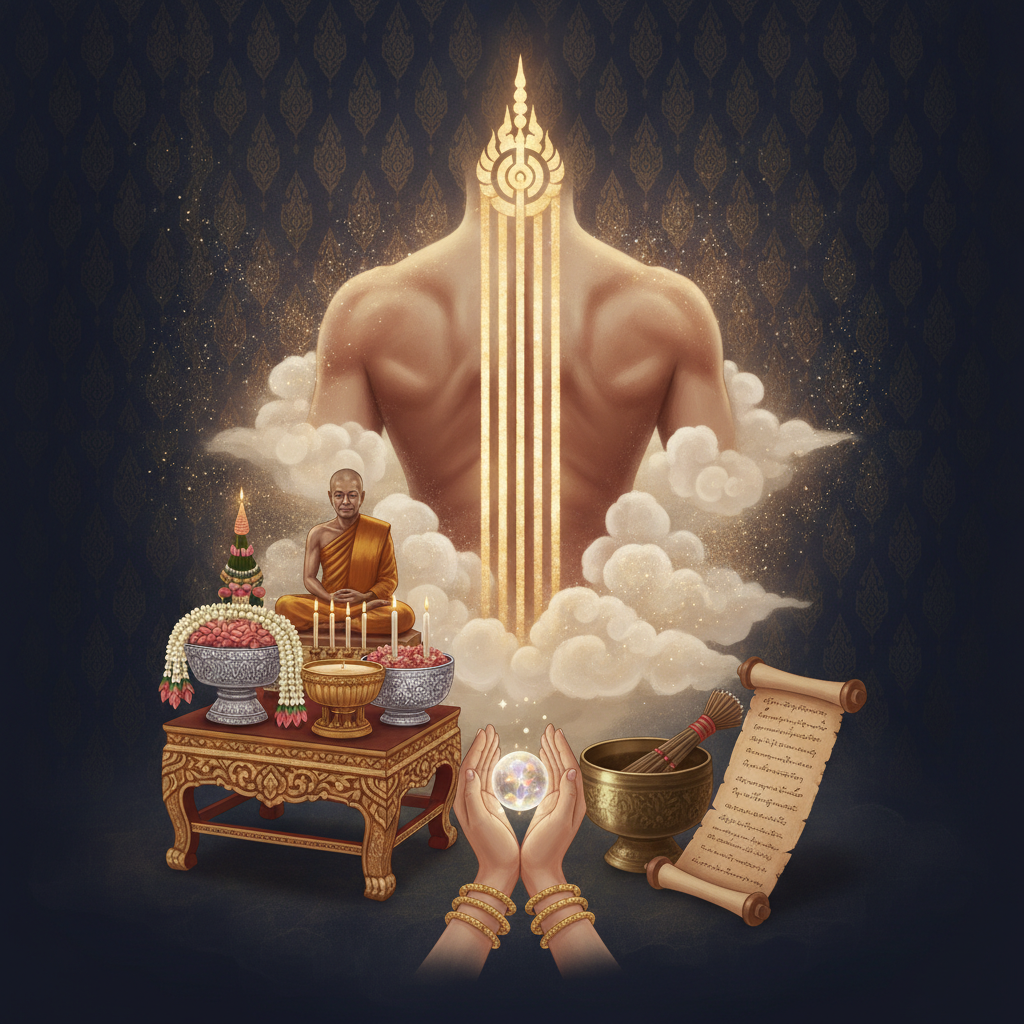
In the world of Thai ritual and belief, Sak Yant Ha Thaew is one of the most widely recognized and sought-after sacred tattoo designs since ancient times. Whether among warriors of old or people today seeking spiritual grounding, this yantra holds profound significance. According to belief, Ha Thaew is not merely a pattern on the skin — it is a sacred incantation permanently enshrined within the body of the one who bears it.
What Is Sak Yant Ha Thaew and Where Does It Come From?
Ha Thaew, known in Pali as "Metta Maha Niyom", is a yantra (sacred geometric design used in Thai occult tradition) composed of five rows of Khom script arranged vertically. Each row contains specific incantations and characters carrying distinct meanings. Ancient texts indicate that these incantations were handed down from a harmonious blending of Buddhist scriptures and Thai esoteric tradition.
According to traditional sources, Ha Thaew originated in Southeast Asia, particularly among Thai, Khmer, and Lao cultures, all of which share similar yantra forms that differ in detail from one lineage to the next. What sets Ha Thaew apart from other yantras is the completeness of its incantations — each row addresses a different domain, encompassing loving-kindness (Metta), charm and attraction (Maha Niyom), invulnerability (Kong Krapan), and good fortune, all within a single design.
The Meaning of Each Row in Ha Thaew
The heart of Sak Yant Ha Thaew lies in the meaning carried by each row. According to those versed in Thai esoteric knowledge, each row holds a distinct power and purpose as follows:
- Row 1 — Concerns Metta Maha Niyom: inspiring love and affection from others.
- Row 2 — Concerns protection from danger and warding off evil.
- Row 3 — Concerns good fortune and prosperity.
- Row 4 — Concerns invulnerability and evasion of harm (Klaew Klaad).
- Row 5 — Concerns the enhancement of personal merit and authority (Baramee).
The specific incantations within each row may vary depending on the lineage and texts used. For this reason, receiving Sak Yant Ha Thaew should always be done with a practitioner who possesses genuine knowledge and has inherited the tradition through a proper lineage.
Popular Variations of Ha Thaew
Although Ha Thaew shares a common foundational structure, different schools of belief and practice have given rise to several popular variations, including the following:
Traditional Ha Thaew
This form is handed down directly from ancient texts, featuring five orderly rows of Khom script. It is most commonly placed on the upper back, below the base of the neck. According to belief, this position allows the yantra's power to radiate most effectively.
Ha Thaew with Naga Head
This variation incorporates a Naga (mythical serpent) or other auspicious creature at the crown of the yantra. The Naga is regarded as a symbol of power and protection, so this style places particular emphasis on shielding the bearer and helping them evade misfortune.
Elemental Ha Thaew
Some schools adapt the incantations in each row to align with the birth element of the recipient — whether Fire, Water, Earth, or Wind — so that the yantra's energy harmonizes as closely as possible with the bearer's own life force. If you are interested in checking your element and natal chart, feel free to use our free fortune-reading tool as a starting point.
Observances for Those Bearing Sak Yant Ha Thaew, According to Belief
Carrying Sak Yant Ha Thaew on the body is not merely a matter of aesthetics. According to ancient Thai belief, those who receive a sacred tattoo must observe certain practices in order to preserve the yantra's power and sanctity.
Prohibitions to Be Mindful Of
- Do not duck under clotheslines or ropes strung at low levels — according to belief, this causes the yantra to lose its potency.
- Do not rest your head on a triangular bolster pillow, or place heavy objects over the area where the yantra is tattooed.
- Do not use coarse language or speak disparagingly of others, as traditional texts hold this to be contrary to the virtue of the Metta incantation.
- Do not engage in sexual relations with someone who already has a partner — according to belief, this drains the yantra of its power.
- Do not consume certain types of meat as specified by the tattooing master, which varies from one lineage to another.
Practices to Uphold the Yantra's Power
- Recite prayers or regularly call to mind the incantations taught by the tattooing master.
- Observe the Five Precepts in full accordance with Buddhist principles.
- Attend the annual Wai Khru ceremony according to tradition, to renew and reinforce the yantra's power.
- Care for the skin in the tattooed area and keep it in good condition, so the yantra does not fade or become distorted.
For those who wish to gain a deeper understanding of their destiny and the auspiciousness in their lives, subscribing to a personalized daily horoscope may help you plan your life with greater mindfulness and care.
The Wai Khru Ceremony and Related Rituals
According to the tradition of those bearing Sak Yant Ha Thaew, the Wai Khru — or "Yantra Master Veneration Day" — is typically held once a year, either at the beginning of the year or on a date set by each individual school. This ceremony is an act of reverence toward the masters who have transmitted the knowledge, and an opportunity to perform a consecration ritual (Pluk Sek) to reinvigorate the yantra carried on the body.
According to belief, those who go a long time without attending the Wai Khru may find the yantra's power gradually diminishing. Maintaining one's connection to the lineage is therefore considered essential for those who are genuinely devoted to this tradition.
Frequently Asked Questions About Sak Yant Ha Thaew
Where on the Body Should Ha Thaew Be Placed?
According to traditional belief and ancient texts, the most favored placement is the upper back, below the base of the neck, as this is considered the central point of one's life force. That said, some schools may recommend other positions depending on the individual's natal chart and personal circumstances. It is advisable to consult a knowledgeable practitioner directly before making a decision.
Can Women Receive Sak Yant Ha Thaew?
According to traditional belief, this is a matter of ongoing discussion. Some schools welcome women; others impose restrictions regarding placement or the type of yantra considered appropriate. Ultimately, this depends on the texts and rules of each particular lineage. Consulting a specialist directly will provide the clearest answer. If you would like further guidance, you are welcome to consult one of our expert masters.
What Should One Do If They Wish to Remove the Yantra?
According to belief, "returning to the master" — the process of releasing the yantra from the body — must be carried out through the proper ritual. One should not attempt to remove or erase the yantra on their own without going through the ceremony, as traditional texts warn this may bring harm to the individual. It is important to contact the tattooing master or a qualified practitioner within the lineage directly, so the process can be carried out correctly and in accordance with tradition.
Sak Yant Ha Thaew is far more than body art. It is the act of permanently receiving ancient incantations and beliefs into one's own body. Those who decide to undergo this sacred tattooing should research the subject thoroughly, understand the observances involved, and choose a practitioner with genuine expertise — so that the yantra may truly serve as a source of auspiciousness and spiritual refuge throughout their life.