If we were to mention one of the deities most widely known and revered throughout Asia, the name of Guanyin would surely rank among the foremost. The legend of Guanyin has roots in both the scriptures of Mahayana Buddhism and ancient Chinese literature, blended together until it became the image of a goddess of compassion that millions of people have held in their hearts for many centuries.
The Legend of Guanyin: From Sutra to Chinese Literature
Version 1 — Avalokiteśvara in the Lotus Sutra
The most ancient origin of Guanyin comes from Mahayana Buddhism, where this Bodhisattva bears the Sanskrit name Avalokiteśvara, appearing in ancient Indian texts as a male figure, not female.
In the Lotus Sutra, Chapter 25, also known as the "Guanyin Chapter" (Universal Gate Chapter), this Bodhisattva is described in detail. It states that when all beings in the world fall into suffering—whether from fire, flood, weapons, or even fear of storms at sea—if that person calls upon the name of Avalokiteśvara with a pure heart, the Bodhisattva will hear that voice and come to deliver them from suffering.
The Chinese name translated from this Sanskrit name is "Guanshiyin" (觀世音), shortened to "Guanyin," literally meaning "the one who hears the sounds of the world", or sometimes translated as "the one who perceives the cries of the world," which fully reflects the essence of the sutra. The sutra also specifies that Avalokiteśvara can manifest in various forms suited to each being in need of help—as a Buddha, a monk, a woman, or even a child. Scholars view this flexibility in the sutra as the opening that allowed Chinese culture later to adapt the form of Avalokiteśvara into a female figure in a way that was harmonious.
It is important to note that in the original Indian and Mahayana sutra texts, Avalokiteśvara is explicitly male. The transformation into a female form occurred later in China, blended with local deity concepts until it became the image familiar to Thai people today.
Version 2 — The Legend of Princess Miaoshan
The legend most widely circulated in Chinese and Thai culture comes from a text known as "The Precious Volume of Xiangshan" (香山寶卷 / Xiangshan Baojuan), which scholars suggest dates to around the 11th century during the Song Dynasty. It is a legend concerning Princess Miaoshan (妙善), the third daughter of a certain Chinese king.
The legend tells that Princess Miaoshan had a disposition inclined toward the dharma from her youth. When her father wished to arrange her marriage according to royal custom, she refused and asked to become a nun instead. Her father was greatly displeased and attempted to force her through various means, including ordering her to do hard labor in a temple, but Miaoshan remained steadfast in her practice.
Eventually, her father ordered her execution, but according to legend, a white tiger carried her body to another realm, and she was able to return to life. She then practiced the dharma intensely until she attained a high level of realization.
The most touching part of the legend comes when her father fell gravely ill with an incurable disease. A great physician said that the medicine to cure him required the arms and eyes of one who harbors no resentment as ingredients. When the king's messengers went searching, they found Miaoshan in her practice. She realized that the patient was her own father—the one who had ordered her death—yet she willingly gave both her arms and both her eyes to make medicine for him, without any trace of bitterness in her heart.
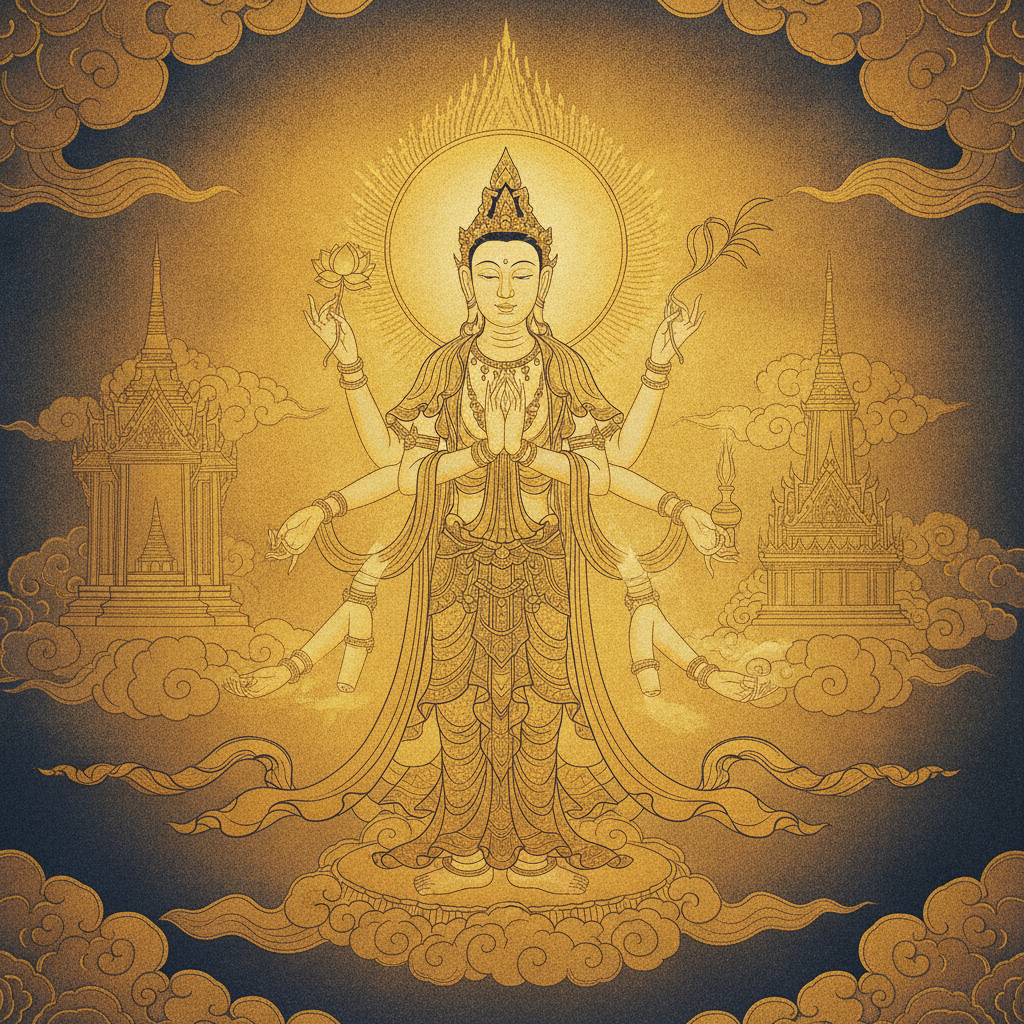
When the father recovered from his illness and learned that it was his own daughter who had sacrificed her limbs, he felt deep remorse and went to beg her forgiveness. At that very moment, a miracle occurred: Miaoshan's body was restored to wholeness and even more perfect than before, with a thousand arms and a thousand eyes. This legend is the origin of the form known as "Guanyin of a Thousand Arms and Thousand Eyes", one of the most renowned manifestations.
It should be noted that the legend of Miaoshan is specifically Chinese and does not appear in the original Mahayana scriptures. It is an excellent example of how Chinese culture received a deity from Buddhism and created a new legend blended with local beliefs, transforming Avalokiteśvara from a male figure into a female goddess in Chinese culture.
Two Versions, Two Worlds
It can be seen that the two legends differ markedly in character. The sutra version emphasizes the power of listening and helping as a great Bodhisattva who comes to aid all beings in their time of suffering, while the Miaoshan version emphasizes gratitude and self-sacrifice in a way highly valued by Chinese culture. The two are not contradictory but stem from different foundations and eras, and devotees of each may place different weight on their respective versions.
The Personality and Character of Guanyin as Reflected in the Legends
When reading both legends together, one finds that Guanyin's personality has several distinctive traits that align in a fascinating way.
Unconditional Compassion — In the Lotus Sutra, she listens to the cries of suffering of all beings without regard to class or status. Whoever calls upon her sincerely, she will hear. In the legend of Miaoshan, she gives her own limbs to her father who once ordered her death, without any resentment whatsoever. This personality makes Guanyin a symbol of boundless compassion.
Sacrifice and Courage — Miaoshan does not yield to pressure from her father and consistently chooses the harder path: refusing marriage, enduring hardship in the temple, and sacrificing her arms and eyes. This trait reflects a commitment to what is right, even at great cost.
Ability to Manifest in Many Forms — According to the Lotus Sutra, she can manifest in forms suited to each being who needs help. This trait makes Guanyin seen as accessible and understanding of all types of people.
Patience and Forgiveness — The legend of Miaoshan shows that even when treated unjustly, she never harbors ill will. This capacity to forgive and let go gives her the special quality to make medicine, since it must come from "one who harbors no resentment."
Together, these traits paint a picture of a deity who is not so grand as to be unreachable, but one who listens, understands, and stands ready to help, which may be the key reason why Guanyin has been beloved by people for so long.
Why Wishes for Health and Relief from Suffering Are So Popular
The popularity of making various wishes to Guanyin all have roots tied to the legends and her personality. While some parts are interpretations passed down through belief and not direct scriptural mandates, they all connect meaningfully.
Health and Relief from Disease — This connects most clearly to the legend of Miaoshan, where she gives her arms and eyes to make medicine to cure her father. The image of Guanyin thus became linked in devotees' minds with healing and health care. It is explained that Guanyin has special compassion for the sick because the legend shows she willingly sacrificed her own body to ease the suffering of another. This is an interpretation passed down through tradition, not a direct statement in the scriptures.
Escaping Misfortune and Protection — The Lotus Sutra, Chapter 25, directly states that those who call upon Avalokiteśvara in times of danger will receive help escaping peril—from fire, water, and various dangers. The belief in seeking protection from misfortune thus has a foundation directly in the sutra.
Safety at Sea — It is explained that Guanyin protects those who must travel by sea, citing passages in the sutra about helping sailors caught in storms. This belief was especially widespread among fishermen and merchants traveling by sea in ancient China.
Having Children — According to passed-down belief, there is a form of Guanyin called "Guanyin Bestowing Children", which those wishing to have offspring particularly seek blessings from. This belief likely arose from blending her personality as a compassionate mother-like figure with the Chinese tradition of placing great value on continuing one's line.
What should be understood is that these beliefs are beliefs passed down through tradition, not guarantees of any outcome. Making wishes is an expression of faith and hope, which has value in itself as a comfort to the heart and a source of encouragement.
Where to Pay Respects to Guanyin
For those wishing to pay respects to Guanyin, there are several important places in Thailand. Here are three famous ones worth recommending.
Guanyin Palace, Chokchai 4 (Bangkok) — Enshrines Guanyin of a Thousand Eyes and Thousand Arms, corresponding directly to the form originating from the legend of Miaoshan. Here it is popular to seek blessings for protecting one's destiny and escaping misfortune.
Guanyin Shrine, Tian Fa Foundation (Bangkok) — Enshrines Guanyin in the form of bestowing blessings, with a wooden carving brought from China beginning in 1958. Here it is popular to seek blessings for health and relief from disease and misfortune, which aligns with the legend of Miaoshan emphasizing healing.
Yi Tong Tian Thai Temple (Prachuap Khiri Khan) — Enshrines the Bodhisattva Guanyin in the form of bestowing blessings, white jade, 2.62 meters high, within a circular hall modeled after the Tianting Tower in Beijing. This is a serene and beautiful place suitable for coming to pay respects and contemplate.
Beyond these three locations, there are many other places to pay respects to Guanyin throughout the country. Additional information can be found at finding places to worship Guanyin throughout the country.
Methods of Worship According to Belief
Regarding specific worship practices and prohibitions in honoring Guanyin, no texts or scriptures clearly establishing standard details have been found. Worship traditions may vary from one temple, shrine, or community to another. It is therefore recommended to ask the officials or caretakers of that particular place directly for accuracy.
However, broad principles applicable to paying respects to sacred things in general are:
- Worship with a calm and sincere heart — According to the essence of both legends, Guanyin hears voices from the heart, not from elaborate rituals.
- Dress respectfully and neatly — This demonstrates respect for the sacred place.
- Respect the rules of the place — Each temple or shrine may have specific practices that should be followed strictly.
- Do not disturb others who come to pay respects — Respect the shared space of all.
If interested in auspicious colors or suitable days to come pay respects, more information can be found at auspicious colors by birth day, wear them to enhance your destiny, luck, and career and lucky calendar telling suitable days to worship.
Frequently Asked Questions
Are Guanyin and Avalokiteśvara the same being?
Yes and no at the same time. Guanyin in Chinese and Thai culture originates from the Bodhisattva Avalokiteśvara in Mahayana Buddhism, but Avalokiteśvara in the original Indian scriptures was male, while Guanyin in Chinese culture is female, due to blending with local beliefs and the legend of Miaoshan that developed later in China. Thus it may be said they are the same in terms of origin, but have developed different forms and legends according to their respective cultures.
Why do some forms of Guanyin have a thousand arms and eyes?
The form of Guanyin of a Thousand Arms and Thousand Eyes (千手千眼觀音) originates from the legend of Miaoshan, which tells that after she gave her arms and eyes to cure her father, a miracle occurred giving her many more arms and eyes than before. The thousand arms have symbolic meaning that she can reach out to help all beings in every direction simultaneously, while the thousand eyes signify her ability to see the suffering of all beings completely.
What religion is Guanyin a deity of?
Guanyin originates from Mahayana Buddhism as the Bodhisattva Avalokiteśvara. However, in China and Thailand, the belief has blended with indigenous Chinese traditions and Taoism, becoming a belief with its own distinctive character. Her devotees thus come from various groups, including Mahayana Buddhists, Taoists, and ethnic Chinese followers of ancestral traditions.
How should one make wishes to Guanyin?
No texts have been found that establish a clear standard method of making wishes to Guanyin for all places. Generally speaking, according to belief passed down through tradition, the best way to make a wish is to come with a calm and sincere heart, set your intention by respectfully expressing your request, and follow the specific practices of that place. If you wish to know the specific details of each individual temple or shrine, you should ask the caretakers of that place directly.
Guanyin is a deity who transcends time and cultural boundaries. Her legends, whether the sutra version about hearing the cries of suffering or the Miaoshan version about unconditional sacrifice, both speak to one thing: boundless compassion, which still resonates in people's hearts today. If you wish to know which deity might be particularly suited to your personal destiny, try asking the white secretary which deity would be most harmonious with your destiny.
References
- The Lotus Sutra, Chapter 25 (Lotus Sutra, Chapter 25: The Universal Gate of Guanshiyin Bodhisattva)
- The Precious Volume of Xiangshan (香山寶卷 / Xiangshan Baojuan) — Chinese text from around the 11th century
- Wikipedia: Guanyin — https://en.wikipedia.org/wiki/Guanyin
- Information on popular wishes — https://travel.trueid.net/detail/XGBOY3XgRea2
- Information on Guanyin Palace, Chokchai 4 — https://www.ktc.co.th/article/travel-guide/thailand/chinese-temple
- Information on Yi Tong Tian Thai Temple — https://thestandard.co/?p=1052024