The Legend of Lakshmi is one of the most beautiful and profound narratives in the Brahmanical-Hindu scriptures. From the image of the goddess emerging from the depths of the ocean with a pink lotus in hand, to her choice to dwell beside the virtuous, every element of the legend reflects layered and meaningful symbolism. The beliefs in this article derive from the Brahmanical-Hindu tradition, which is distinct from Buddhism, though both have been harmoniously intertwined in Thai culture for a long time.
The Legend of Lakshmi's Birth: Two Different Accounts
The Brahmanical-Hindu scriptures relate the birth of Lakshmi in at least two principal ways, and both accounts differ significantly in detail. Those interested should know both versions in order to understand which source the currently widespread legend derives from.
The First Account: Emerging from the Ocean of Milk (Kshira Sagara)
According to the Vishnu Purana, which is the principal scripture recording the tales of Vishnu and his retinue, there is an account of an event called the Churning of the Ocean of Milk, or the churning of the milky sea. This was a collaboration between the devas and asuras seeking to obtain amrita (amritam), which was believed to grant immortality to those who drank it.
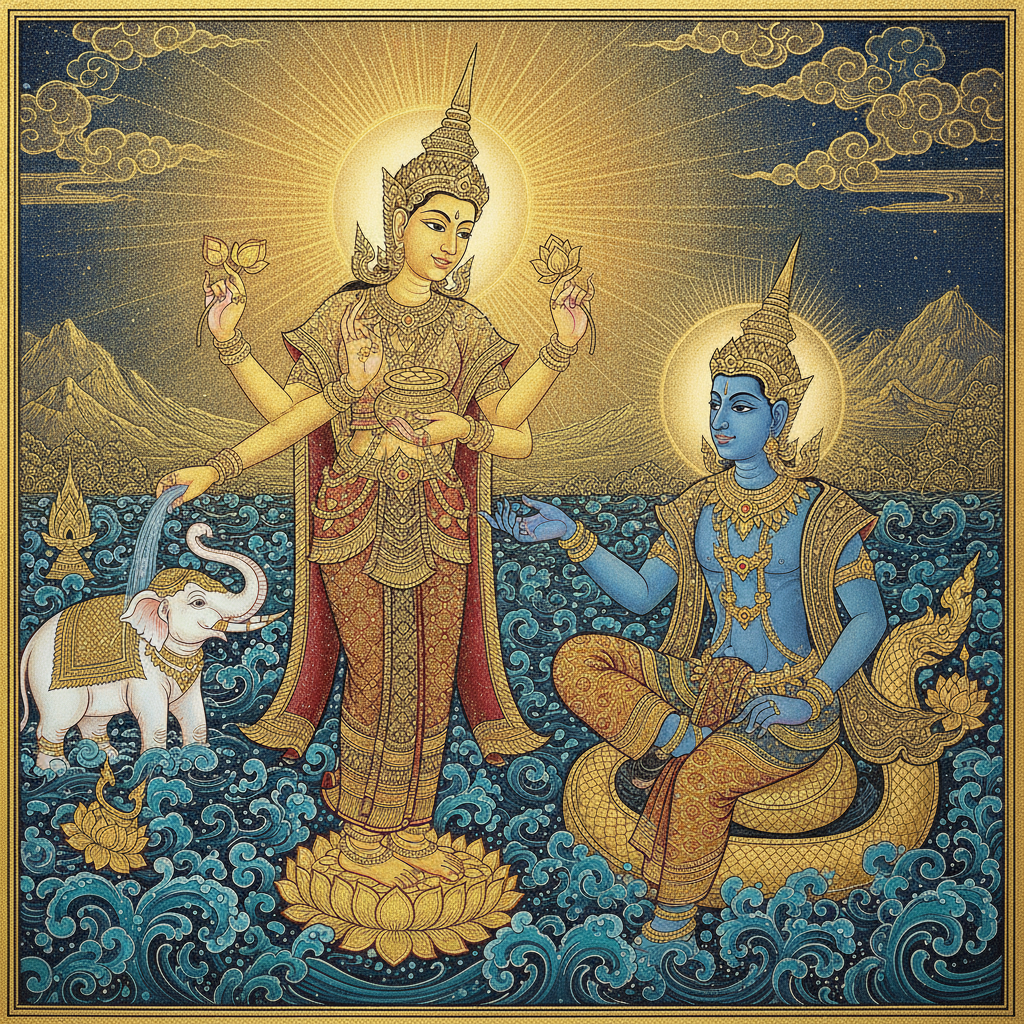
During this great churning of the ocean, many precious and sacred things emerged from the waters one by one, and among them was Lakshmi, who appeared with a lotus in her hand, radiating beautiful and brilliant light. The devas were astonished and offered their welcome, but what is noteworthy is that the goddess did not remain there long, for she chose with her own will whom she would stand beside.
According to the Vishnu Purana, Lakshmi chose Vishnu, the god of protection and sustenance of the world, as her consort. This choice was not by chance, for Vishnu is the representative of goodness, peace, and the protection of the universe. The fact that the goddess of wealth and beauty chose to dwell beside the god of virtue became an important symbol that many Hindu scriptures interpreted to mean that wealth and goodness should go together.
The most familiar image of Lakshmi in this account is of the goddess seated on a lotus with two elephants standing on either side, which Hindu scholars explain as elephants being symbols of abundance and purification.
The Second Account: Daughter of the Sage Bhrigu
Another account appearing in other scripture collections tells that Lakshmi did not emerge from the sea, but was originally the daughter of the sage Bhrigu, one of the great sages in Hindu scriptures. In this version, the goddess was originally born as an exalted human before being elevated to divine status later.
These two accounts do not contradict each other in essence, for both affirm that Lakshmi is the consort of Vishnu and is the embodiment of wealth, beauty, and abundance, but they differ in the point of origin. Scholars of Hindu scriptures therefore often note that the most widespread legend today comes from the account of the churning of the ocean of milk, which originates from the Vishnu Purana.
The Goddess Dwells with Those of Virtue
Apart from the account of her birth, the Shatapatha Brahmana, an ancient Brahmanical scripture older than many Puranas, has recorded an important concept concerning Lakshmi: the goddess's dwelling depends on the virtue of that person. That is, she does not reside with every wealthy person, but with those who possess virtue and conduct themselves well. This concept makes Lakshmi different from deities of fortune in many cultures, for she is not a god who grants wealth unconditionally, but rather wealth received must come together with goodness.
This concept is further reflected in the Mahabharata and many Hindu literary works, which recount that whenever a ruler or leader lacks virtue, Lakshmi abandons that place and goes to dwell elsewhere, causing prosperity to decline. Conversely, when anyone conducts themselves well, wealth and happiness follow in their wake.
In the Mahabharata and Ramayana, Lakshmi also appears in the role of Sri Devi, the embodiment of beauty, fortune, and prosperity, who dwells beside Vishnu in every avatar in which he descends to vanquish evil in the world. For example, when Vishnu became the avatar of Rama, Lakshmi became the avatar of Sita, and when he became Krishna, she became Rukmini, and so forth. This binds the two deities inseparably together in Hindu legend.
The Personality and Character of Lakshmi as Reflected in the Legends
From the legends told, the personality of Lakshmi as it appears in the scriptures can be summarized in several aspects, each of which derives directly from the content of the scriptures.
- She is the embodiment of wealth and abundance — The Vishnu Purana and various Mahabharatas alike describe the goddess as the representative of riches, fortune, and worldly good things.
- She is graceful and dignified — The image appearing in the scriptures is of the goddess adorned in red and gold, decorated with precious ornaments, seated on a lotus, which is a symbol of purity blooming in muddy waters.
- She chooses to dwell according to virtue, not according to power or wealth — According to the Shatapatha Brahmana, the goddess dwells with those who conduct themselves well and possess virtue, not with everyone indiscriminately. This personality makes the goddess more meaningful than an ordinary god of fortune.
- She is a loyal and steadfast life partner — The fact that the goddess follows Vishnu in every avatar reflects a personality of loyalty and enduring love, which many scriptures hold up as an ideal in a spouse.
- She possesses compassion — In many legends, the goddess intercedes with Vishnu on behalf of humans, or helps mediate to bring relief to those in suffering.
These personalities combined make Lakshmi a multidimensional goddess, encompassing beauty, wealth, and virtue, which in Brahmanical-Hindu belief should not be separated from one another.
Why People Seek Blessings from Lakshmi on Various Matters
The popularity of seeking blessings from Lakshmi on various matters has reasons linked back to the legends and personalities described above, though some parts represent interpretations passed down within practitioner communities rather than direct explanations from the scriptures.
Finance, Commerce, and Fortune
This reason is most directly linked to the legend, for the Vishnu Purana and Mahabharata clearly describe the goddess as the embodiment of wealth. The word "Lakshmi" in Sanskrit itself means fortune and riches, so seeking blessings on financial and business matters has the most direct origin in the legend. However, as the Shatapatha Brahmana points out, the wealth sought should be paired with virtuous conduct. According to belief in this tradition, seeking only without adjusting one's behavior may not align with the essence of the legend.
Love and Spouses
There is an explanation that seeking blessings from Lakshmi regarding a spouse is linked to the fact that the goddess is the beloved consort of Vishnu and follows him in every avatar. This has made the goddess a symbol of enduring love and bonds in married life. However, this is an interpretation passed down among practitioners, not a direct statement in the scriptures cited in this article.
Children
There is an explanation that as the goddess of abundance and domestic happiness, Lakshmi is associated with seeking children as well, since children are considered part of life's prosperity according to Brahmanical-Hindu principles. However, this section represents an interpretation widely held among practitioners, not something explicitly stated in the scriptures cited in this article.
What is important to know is that according to Brahmanical-Hindu belief, seeking blessings for wealth from Lakshmi is usually coupled with conducting oneself well, for the legend in the Shatapatha Brahmana clearly emphasizes that the goddess dwells with those of virtue. Therefore, seeking blessings is not merely supplication, but also involves a commitment to conduct oneself appropriately.
If interested in learning about a god of fortune in the Buddhist tradition, you can read more at Phra Sewal Ek Thak Thalam Sak Kara, the Excellence in Fortune, which represents another distinct tradition of belief.
Where to Worship Lakshmi
In Bangkok there are important places where Lakshmi is enshrined and open for devotees to pay respects and seek blessings. We recommend the following three locations.
Lakshmi Shrine at Kasem Village Floor 4 (Bangkok)
According to popular belief, this shrine is favored for seeking blessings on love, fortune, commerce, and business negotiations. Offerings listed by sources include 9 incense sticks, pink lotus, fruits with mild flavor in 5 varieties (such as coconut), plain water, milk, and sugarcane juice. It is forbidden to bring meat offerings.
Wat Thepamontian (Bangkok)
This temple has Vishnu and Lakshmi as principal deities. According to popular belief, it is favored for seeking blessings on love and spouses. Offerings listed by sources include sweets, flowers, pink lotus, and fruits. Offerings must be brought by the devotee themselves, and it is forbidden to bring meat, liquor, alcohol, or cigarettes.
Wat Phra Sri Maha Uma Thewi (Wat Khek, Silom) (Bangkok)
This temple has Lakshmi among its divine images. According to popular belief, it is favored for seeking blessings on love and children. Offerings listed by sources include 9 fragrant incense sticks, sesame oil, plain water, red water, milk or sugarcane juice, and sweets. Meat offerings are forbidden.
For those living outside Bangkok or wishing to find other locations: Search for places to worship Lakshmi throughout the country
Methods of Worship According to Belief
The offerings and prohibitions listed in this article come from information gathered from each location and may differ from place to place. It is advisable to verify with the actual location first.
Things that have been consistently noted across multiple locations are:
- Pink lotus flowers often appear in multiple places, consistent with the goddess's image in the legend of holding a lotus
- Milk and sugarcane juice are commonly found as offerings
- Fruits with mild flavor and no pungent odor
- Prohibition of meat, liquor, alcohol, and cigarettes at all locations listed
Regarding information about mantras, directions, or appropriate times and days for worshipping Lakshmi specifically, no authoritative texts have been found that specify this clearly. If any location has additional recommendations, those should be followed according to that location's rules.
A general principle that applies broadly is to worship with a calm and sincere mind, dress respectfully and neatly, respect the rules of the location, and remember that according to the essence of the legend, seeking wealth should be accompanied by a commitment to conduct oneself well.
Frequently Asked Questions
Are Lakshmi and Laksana the same deity?
Yes, they are the same. "Laksana" is a Thai pronunciation of the Sanskrit word "Lakshmi." Both names refer to the same goddess in Brahmanical-Hindu scriptures.
Did Lakshmi emerge from the sea or was she born from the sage Bhrigu?
The legend has two accounts that differ. The most widespread account according to the Vishnu Purana tells that the goddess emerged from the Ocean of Milk (Kshira Sagara) during the churning to obtain amrita. Another account in a different group of scriptures tells that the goddess was originally born as the daughter of the sage Bhrigu. Hindu scriptures comprise many texts and many traditions, so such differences are normal.
Why are meat offerings forbidden to Lakshmi?
This prohibition comes from the rules of each location compiled in this article, which all state it consistently. However, no authoritative texts clearly stating the reasoning have been found in verifiable sources. Generally, in many Brahmanical-Hindu ritual traditions, offering pure things and avoiding meat offerings is a common practice, though specifics depend on each particular tradition.
Will seeking blessings for wealth from Lakshmi produce results?
This article cannot guarantee any results. According to Brahmanical-Hindu belief, seeking blessings for wealth from Lakshmi should be paired with conducting oneself well, for according to the Shatapatha Brahmana, Lakshmi dwells with those of virtue. Worship is therefore an expression of devotion and mental commitment, while the results received depend on individual belief and conduct.
Lakshmi in Brahmanical-Hindu legend is a goddess with meaning deeper than merely a god of fortune. She is a symbol that wealth, beauty, and virtue should exist together, not separately. The legend of her emergence from the Ocean of Milk and her independent choice of Vishnu further emphasizes that the goddess possesses free will and chooses what is good. For those interested in worship, understanding the legend behind it will give the act of paying respect deeper meaning.
If you want to know which divine being is particularly suited to your destiny, try asking the assistant which deity you should worship according to your destiny, or check suitable days for worship at the auspicious calendar that suggests lucky days to pay respects.
References
- Wikipedia: Lakshmi — https://en.wikipedia.org/wiki/Lakshmi
- Information on popular blessings sought and offerings — https://travel.trueid.net/detail/1OG4RyjGMY9P
- Vishnu Purana — the principal scripture recording the legend of the churning of the Ocean of Milk and Lakshmi's birth
- Shatapatha Brahmana — an ancient Brahmanical scripture recording the concept of Lakshmi's dwelling according to virtue