When talking about the legend of Rahu, many people picture a dark shadow creeping across and swallowing the sun or moon during an eclipse. But behind that phenomenon lies a long story of a bold demon who drank divine nectar and was punished in an unexpected way. This legend exists in both the Hindu version, told through the Mahabharata and Puranas, and in the Buddhist Tripitaka, with the two traditions recounting Rahu's story in remarkably different ways.
The Legend of Rahu: Two Different Narratives
The Hindu Version — The Churning of the Ocean of Milk and Dismemberment
According to records in the Mahabharata and several Puranas, Rahu's story begins in an age when devas and asuras agreed to work together to churn the Ocean of Milk to obtain amrita (amritam), the divine nectar whose drinker would become immortal and never die.
The churning used Mount Sumeru as a churning rod and the serpent Vasuki as a rope. Both sides took turns pulling until the ocean spun, and it took great effort before the amrita appeared. When the nectar surfaced, their agreement collapsed. The asuras tried to seize the amrita for themselves.
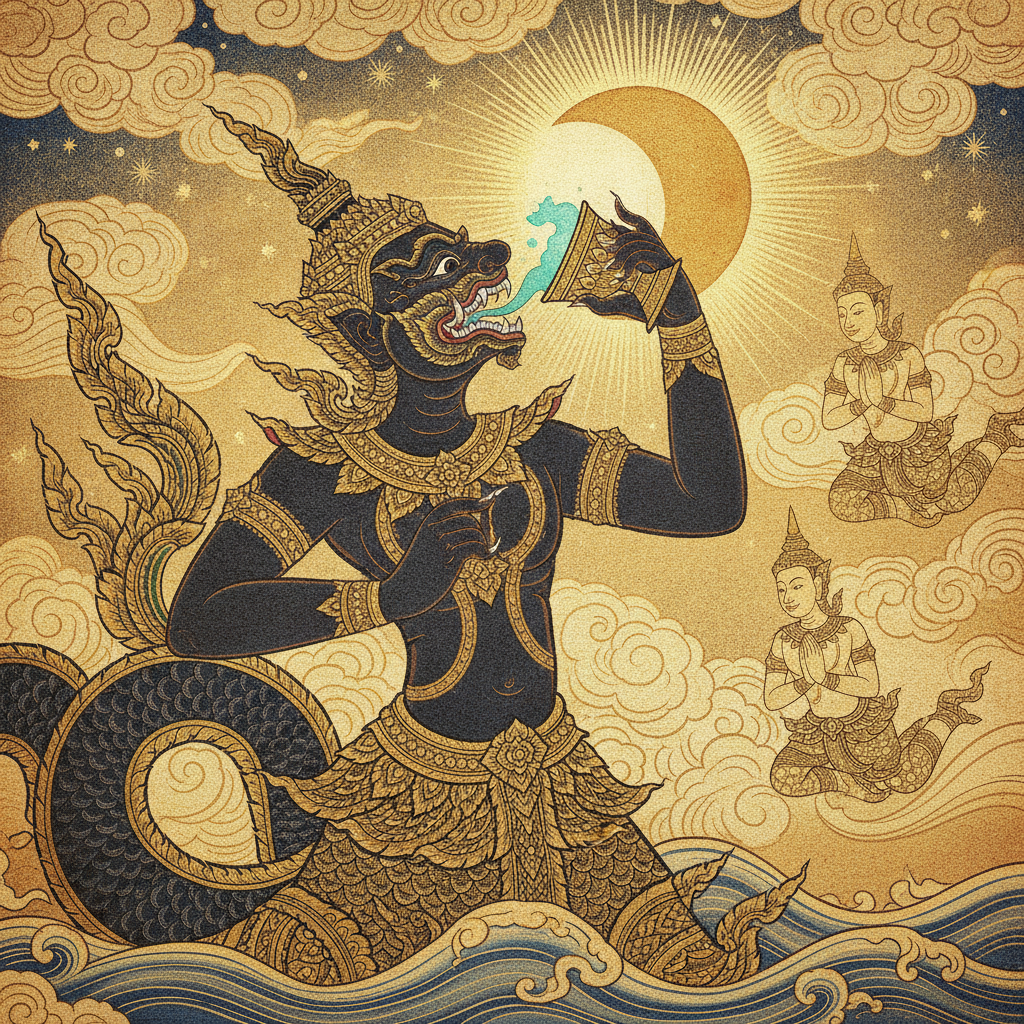
At this point, Vishnu descended in the form of Mohini, a beautiful woman whose charm mesmerized the asuras, and distributed the amrita only to the devas. Most asuras were so enchanted they didn't notice, but one asura named Svarbhanu was clever enough to see through the deception. He disguised himself as a deva and sat in the ranks of the gods, successfully drinking the amrita.
However, the Sun and Moon, sitting nearby, noticed that the seated figure was not a true deva and informed Vishnu. Hearing this, Vishnu threw his Sudarshana Chakra and severed Svarbhanu's body immediately. But because the amrita had already passed down the throat before the chakra struck, Svarbhanu's head became immortal and could not die.
From then on, the immortal head became known as Rahu, while the severed body became Ketu. Rahu, bearing a grudge against the Sun and Moon for informing on him, pursued and swallowed them both. But since Rahu has only a head without a body, the Sun and Moon always escaped through the throat. This phenomenon is believed to be the origin of solar eclipse (when Rahu catches the Sun) and lunar eclipse (when Rahu catches the Moon) according to Hindu belief.
In Hindu and Thai astrology, Rahu and Ketu are counted as a pair of shadow planets without real physical bodies, but referring to the intersection points of the Moon's orbit with the ecliptic, which are the actual points that cause eclipses in astronomy as well.
The Buddhist Version — The Chandra Sutta and Surya Sutta
In the Tripitaka, in the Samyutta Nikaya section, there are two suttas that directly mention Rahu: the Chandra Sutta and the Surya Sutta, which tell a story clearly different from the Hindu version.
In the Chandra Sutta, it is told that Rahu caught the Moon. The Moon remembered the Buddha and spoke a verse to him saying: Honored Buddha, I turn to you for refuge. Rahu has caught me. Please be my refuge.
The Buddha heard and said to Rahu: The Moon has turned to me for refuge. Release the Moon. Rahu immediately released the Moon and hurried to Vepacitti, the great asura lord, in fear. The Surya Sutta tells a similar story but concerning the Sun instead.
What is notable is that in the Buddhist version, Rahu was not dismembered, and there is no mention of amrita or the churning of the ocean. The narrative emphasizes turning to the Buddha for refuge and the power of the Triple Gem, which is authentically Buddhist.
Observations When Comparing the Two Versions
Rahu catches the Sun and Moon and Rahu must release them in the end are common points in both versions. But the reasons for release are entirely different. The Hindu version emphasizes that Rahu has only a head without a body, so both naturally slip out. The Buddhist version emphasizes that Rahu releases them out of fear of the Buddha's power. This difference reflects how the legend of Rahu has been interpreted and adapted to fit the context of each religion and culture.
There are also local Thai stories regarding the relationship between Rahu and the Sun and Moon from other angles, but no clear scriptural or reference sources have been found, so we refrain from mentioning them here for accuracy.
The Personality and Character of Rahu Reflected in the Legend
After reading both versions of the Rahu legend, one can see that Rahu has a distinctive and complex personality in his own way.
Cleverness and Courage: Svarbhanu did not enter to seize the amrita by force, but used wit to transform himself and hide among the devas. This is a form of cleverness praiseworthy even if demonic in nature, though the purpose was deception.
Refusal to Accept Defeat and Grudge: Even after being dismembered to merely a head, Rahu harbored no forgiveness, continuing to pursue the Sun and Moon who informed on him throughout eternity. This endless persistence made Rahu a symbol of a stubborn, unstoppable force.
Representative of Delusion and Darkness: In Thai and Hindu astrology, Rahu is classified as a malefic planet, representing shadow, darkness, mystery, and hidden things. This personality aligns with the legend where Rahu hides in darkness, acts covertly, and obscures light. According to Thai astrological data, Rahu's colors are gray, smoke, and bronze, his number is 8, and his planetary strength is 12.
Reverence Toward Superior Power: In the Buddhist version, though Rahu is powerful enough to catch the Sun and Moon, he still fears the Buddha's power and hastily releases them, showing that even a great asura has his limits.
These traits make Rahu a deity both feared and respected at once—not a god of beauty in the familiar sense, but a force requiring understanding and compromise.
Why is it Popular to Ask for Blessings Regarding Clearing Misfortune and Good Fortune
The belief in worshiping Rahu is clearly rooted in the legend and Rahu's role in astrology. There are explanations as to why people commonly ask for blessings in these areas, based on Rahu's symbolic meaning.
Clearing Misfortune: Since Rahu is classified as a malefic planet in Thai and Hindu astrology, it is explained that when the Rahu planet transits through positions affecting a person's fate, it may cause obstacles or karmic consequences. Worshiping Rahu is thus seen as asking him to ease or mitigate those effects, similar to how in the Buddhist tale the Sun and Moon had to rely on superior power to make Rahu release them.
Remedies During Rahu's Transit: In Thai astrology, Rahu changes zodiac signs approximately every eighteen months. During periods when Rahu transits or affects important planets in one's chart, it is explained that people commonly worship Rahu to ask that the change unfold favorably, or at least not cause great harm.
Good Fortune: Although Rahu is a malefic planet, in Thai astrology Rahu also has an auspicious side, particularly regarding unexpected fortune or reversals of fate. It is explained that this aligns with the legend where Svarbhanu managed to drink the amrita unexpectedly, even if the fortune came through unconventional means.
However, we must emphasize that these blessings are inherited beliefs with no guarantees. Worshiping with a calm mind and faith is more important than expecting certain results.
For those interested in making offerings and fulfilling vows after asking for blessings, further reading is available at Making Offerings and Fulfilling Vows: How to Do It Correctly According to Thai Belief
Where to Worship Rahu
Places to pay respect to Rahu are found throughout Thailand, each with its own character and atmosphere. We recommend some as follows:
Wat Sirisathong, Nakhon Pathom Province — An ancient temple renowned for its large Rahu image. People commonly visit to pay respects, especially on Wednesdays and Sundays, as well as during Rahu's zodiac transit periods. The temple offers a set of eight black items for sale for those wishing to make offerings according to belief.
Thewalaï Phrapikanes, Huai Khwang, Bangkok — This place has a Rahu image enshrined together with Phrapikanes. During Rahu's zodiac transit, it is popular to worship at night. Recommended offerings according to belief include black items and eight black incense sticks.
Wat Sao Hin, Chiang Mai Province — An ancient temple built in 1919, enshrining Thao Asurin Rahu, with ceremonies for clearing misfortune. It is suitable for those wishing to perform rituals following ancient practices.
To find Rahu worship places in other provinces, you can search at Search for Rahu Worship Places Throughout Thailand
Worship Method According to Belief
Regarding offerings and detailed methods of worshiping Rahu, the team has compiled this in a dedicated article available at Worshiping Rahu: Eight Black Items, which covers both the list of offerings and worship procedures.
For general principles applicable to worshiping all deities: worship with a calm and respectful mind, dress properly and neatly, and follow the customs of that particular place, as each temple or shrine may have different practices.
Regarding auspicious days and times, according to Thai astrology belief, Rahu is associated with Wednesday night (for those born on Wednesday after 18:00). Rahu is the patron deity of those born on Wednesday night, with Garuda as the vehicle. However, regarding generally auspicious days for worship, there is no clear textual specification beyond the practices of individual locations.
Frequently Asked Questions About the Rahu Legend
Are Rahu and Ketu the Same Thing?
No, they are not the same, but they originate from the same original body. According to the Hindu legend in the Mahabharata and Puranas, when Vishnu severed Svarbhanu's body with the chakra, the immortal head became Rahu while the severed trunk became Ketu. The two are therefore different parts of the original body, and in astrology they are counted as separate shadow planets with different influences.
Why Does Rahu Pursue the Sun and Moon When Neither of Them Dismembered Him?
According to the Hindu legend, the Sun and Moon were the ones who noticed Svarbhanu hiding among the devas and informed Vishnu. Rahu thus held both responsible for his punishment. This grudge has been passed down as the reason Rahu pursues both throughout eternity. In astronomical terms, this aligns with the reality that eclipses occur when the Sun, Moon, and Earth align at the intersection of their orbits.
Which Version is Correct—Buddhist or Hindu?
Both are legends with clear sources in their respective scriptures. Neither is more correct than the other. The Hindu version appears in the Mahabharata and Puranas, while the Buddhist version appears in the Samyutta Nikaya of the Tripitaka. Both reflect different worldviews and values of their respective religions and cultures. Understanding both versions provides a more complete picture of the Rahu legend.
Do People Born on Wednesday Night Need to Worship Rahu Specially?
According to Thai astrology belief, those born on Wednesday between 18:00 and before 06:00 on Thursday have Rahu as their patron deity, with Garuda as the vehicle. It is explained that worshiping Rahu may be of special benefit to this group according to belief. However, those born on other days can also pay respects to Rahu. Worship depends on the faith and intention of each individual.
Summary
The legend of Rahu is a story with depth and multiple dimensions. Whether viewed from the Hindu version telling of a clever demon who paid the price of greed through dismemberment, or the Buddhist version showing that even a powerful asura fears the might of the Triple Gem, both offer thought-provoking perspectives on the nature of greed, grudge, and the power of the sacred.
The belief in Rahu in Thailand blends both Brahmanical-Hindu and Buddhist traditions, becoming a belief uniquely Thai. If you are interested in which deity is best suited to your chart specifically, you can consult at Ask our Assistant Which Deity Suits Your Chart, or view auspicious days for worship at Lucky Calendar Showing Auspicious Days to Worship
References
- Wikipedia: Rahu — https://en.wikipedia.org/wiki/Rahu
- Popularity of Worshiping Rahu — https://travel.trueid.net/detail/dl4NJvbeX2MW
- The Mahabharata (Mahābhārata) — Hindu epic scripture, mentions the legend of Svarbhanu and the churning of the Ocean of Milk
- The Puranas (Purāṇa) — Mention Rahu and Ketu in the context of Hindu astrology and cosmology
- Chandra Sutta and Surya Sutta — Samyutta Nikaya, Tripitaka, mention Rahu catching the Moon and Sun