When we talk about the legend of Thao Wessuwon, many people think of a large giant figure holding a club, standing in a temple or shrine where people come to request blessings for wealth and protection. But behind that awe-inspiring appearance lies a legend from ancient scriptures in both Buddhist and Brahmanical-Hindu traditions that recount the origin, power, and role of this deity in fascinating detail. This article will explore the roots of the legend and explain why these two traditions of belief have merged to form the reverence of Thao Wessuwon in the Thai form we know today.
The Legend of Thao Wessuwon: Two Scriptural Traditions Converge
The Buddhist Tradition: Thao Wessawan, the Great Giant of the North
In Buddhist scriptures of the Theravada school, particularly in the Pali Canon and its commentaries, Thao Wessawan (Vessavaṇa) is mentioned as one of the four Lokapalas or Great Kings, celestial beings who rule the heaven of Chaturmaharajika, the first heaven in Buddhist cosmology. The four Great Kings divide responsibility for guarding the four directions: Thao Dhataratha (east) rules the Gandharvas, Thao Virupaksha (west) rules the Nagas, Thao Virudhaka (south) rules the Kumbhandas, and Thao Wessawan (north) rules the Yakshas.
It is noteworthy that in Buddhist understanding, "Wessawan" is not the name of a single individual throughout time, but rather a position title held by successive beings, similar to how the position of Indra changes when one's merit is exhausted. Therefore, the stories of Thao Wessawan in different eras may have varying details.
The most important role of Thao Wessawan in the Pali Canon appears in a discourse called the Atanata Sutta, found in the Digha Nikaya, Silakkhandha-vagga. It recounts how once the four Great Kings, along with many yakshas in their retinue, came before the Buddha at Gijjhakuta mountain in Magadha. Thao Wessawan respectfully told the Buddha that many yakshas in his retinue were not yet devoted to Buddhism and might cause trouble to monks, nuns, male lay followers, and female lay followers who were practicing in forests or remote places.
Desiring to protect the Buddhist community, Thao Wessawan offered the Buddha the Atanata Paritta, a protective chant comprising praise of seven Buddhas of the past and possessing the power to protect against harm from yakshas and malevolent spirits. The Buddha accepted it and instructed the Buddhist community to remember and recite it for protection. The Atanata Paritta thus became one of the important chants that Thai clergy recite in blessing ceremonies to this day.
The Brahmanical-Hindu Tradition: Thao Kubera, the God of Wealth Expelled from Lanka
In Brahmanical-Hindu understanding, this same deity is known as Kubera (Kubera), whose legend differs clearly. According to the epics Ramayana and several Puranas, Kubera is the son of the rishi Vishravaṣ and Ilwila, the deity ruling the northern direction (Uttara Kuru) and honored as the treasurer of the gods, or god of wealth and prosperity. He possessed the beautiful city of Lanka and a divine vehicle called "Pushpaka Vimana".
But the most famous legend of Kubera in the Hindu tradition is the loss of Lanka. According to the Ramayana, Dashanantha (a rakshasa/great yaksha) was Kubera's half-brother, that is, Dashanantha was also the son of rishi Vishravaṣ, but born from Kaikasi, a yaksha woman. Through fierce austerities, Dashanantha received boons from Brahma and used that power to expel Kubera from Lanka and seize the Pushpaka Vimana. Kubera had to move and reside instead in the city of Alaka on Mount Kailasa.
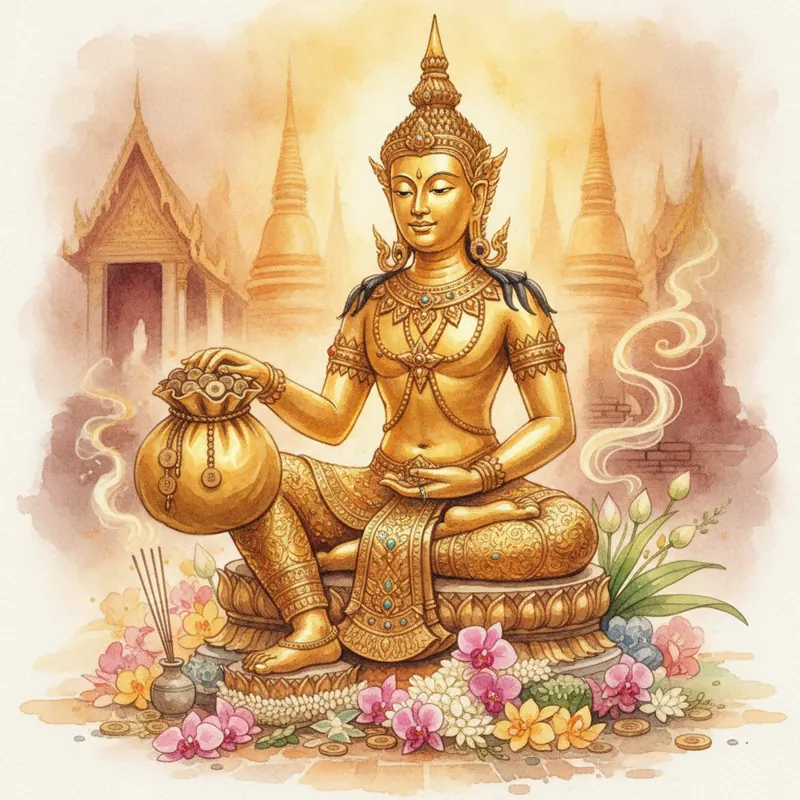
Although he lost Lanka, Kubera retained his position as god of wealth and prosperity, protector of the northern direction, and remains one of the eight Ashtadikapalas (protectors of the eight directions) in Hindu belief. He typically appears in the form of a stout, fair or yellow-skinned figure, holding a bag of gold or a club, surrounded by abundant wealth.
When Two Legends Converge in the Thai World
The Thai belief in Thao Wessuwon represents a fusion of the Buddhist understanding (Thao Wessawan, the great giant of the north) and the Brahmanical-Hindu understanding (Thao Kubera, god of wealth) that have become inseparably blended in the worship of common people—a characteristic feature of "Thai Buddhism" that has merged various traditions since ancient times. Both traditions share an important common ground: they rule the north, govern yakshas, and possess power beyond ordinary human reach, merging harmoniously in the imagination of worshippers.
The Personality and Character of Thao Wessuwon Reflected in Legend
From both legends, the most evident personality trait of Thao Wessuwon is being the supreme power over all yakshas and malevolent spirits, yet interestingly, he does not use that power to oppress others, but rather maintains it in accordance with righteousness and protects those of good conduct.
In the Pali Canon, Thao Wessawan's approach to the Buddha and offering of the Atanata Paritta reflects that he is devoted to Buddhism and shows compassion toward the Buddhist community. Even though some yakshas in his retinue are not yet devoted, he still takes responsibility by finding a way to protect the Buddhist community from these yakshas, showing the character of a responsible leader toward both his retinue and those he is meant to protect.
In the Hindu tradition, although Kubera lost Lanka to Dashanantha, he neither declined nor lost his power, continuing to hold the position of god of wealth and protector of the north. This reflects the personality of one steady in status and role, despite facing loss.
Overall, Thao Wessuwon in legend has three outstanding personality traits: a righteous ruler who uses power over yakshas to protect rather than harm, one devoted to righteousness who, though a great giant, bows respectfully to the Buddha and offers protection for the benefit of the Buddhist community, and lord of wealth who controls treasure and manages the resources of the gods. These three traits are what make people believe that worshipping him will bring both protection and prosperity.
Why People Commonly Seek Blessings from Thao Wessuwon
Requesting Protection from Evil and Malevolent Spirits
The most straightforward reason comes from the Pali Canon legend, which clearly states that Thao Wessawan offered the Atanata Paritta to protect the Buddhist community from yakshas and malevolent spirits. Since he is a great giant with power over such things, requesting his blessing for protection from evil directly connects to the legend.
In ancient Thai culture, according to widely circulated accounts (though not specifically stated in scriptures), there was a custom of tying a yantra with a giant figure to the head of a child's bed so that Thao Wessuwon, as a great giant, would protect the child from evil that might come to disturb. This belief reflects people's confidence that he truly has the power to command yakshas and malevolent spirits.
Requesting Business, Property, and Wealth
This belief comes directly from the Brahmanical-Hindu tradition. In Hindu understanding, Thao Kubera is the god of wealth and treasure and the treasurer of the gods, possessing abundant riches. Worshipping him is thus believed to aid business ventures, prevent loss of property, and attract wealth—according to popular belief (not as a guarantee).
Requesting Protection During Travel
As a great giant protecting the north and wielding power over things that may be hazardous during long journeys, according to widespread belief, people commonly request his blessing to protect their travels, especially long journeys through forests, mountains, or remote places, which in the past were believed to be inhabited by entities under Thao Wessuwon's governance.
Requesting Success in Work
This belief follows from his role as god of wealth and one possessing great merit and influence. According to popular belief, worshipping Thao Wessuwon helps enhance merit and advancement in one's career, as he himself holds a high position and manages a large retinue.
For those interested in auspicious objects to enhance work fortune, more can be read at 6 Auspicious Objects for Your Desk: Where to Place Them to Enhance Career and Advancement by Feng Shui?
Where to Worship Thao Wessuwon
Wat Suthat Thepwararam Royal Temple (Bangkok) is one of the most popular places for people to pay respect to Thao Wessuwon in Bangkok. It is recommended to pay respects to the main Buddha image in the vihara first, then proceed to pay respects to Thao Wessuwon.
Wat Chulalongkorn (Samut Songkhram) is another popular place where people come to request blessings for work, finances, trade, and protection during long journeys. According to available information, popular offerings include incense, candles, rose flowers or 9 flowers, and 5 auspicious fruits.
Wat Phra Sri Rattana Mahadhatu Rachworamahaviharn (Wat Yai), Phitsanulok Province has a bronze statue of Thao Wessuwon located near the base of Phra Phutthachinaarat Buddha image. Visitors commonly request blessings for victory, merit and influence, and protection. It is considered a highly sacred place as it is in the same compound as Phra Phutthachinaarat, which is deeply revered by the people of Phitsanulok.
Looking for places to worship Thao Wessuwon in other provinces nationwide: Find Thao Wessuwon Worship Sites Throughout Thailand
Methods of Worship According to Belief
Regarding offerings and practices documented from actual places, there is Wat Ratsadharma (Wat Bang Chan), Bangkok, where people commonly request blessings for wealth, money, and family happiness. According to the sources, popular offerings include auspicious objects, incense, and three-colored cloth that people commonly tie to the club of the deity after receiving the blessing.
As for other requirements such as the most auspicious day to worship, specific chants, or special prohibitions beyond what each temple specifies, no texts have been found that clearly state a uniform standard. It is recommended to follow a broad principle: worship with a calm mind, dress respectfully, respect the customs of that particular place, and always pay respects to the main Buddha image in the chapel or vihara first when at a temple.
For those wishing to study worship methods, chants, and beliefs about wealth enhancement in detail, more can be read at Worshipping Thao Wessuwon: Methods, Chants, and Beliefs for Wealth Enhancement and Protection from Evil
Frequently Asked Questions
Are Thao Wessuwon and Thao Kubera the Same Deity?
From an academic perspective, scholars of comparative religion view Thao Wessawan in Buddhism and Thao Kubera in Hinduism as having the same origins but developing in different contexts. In Buddhism, Thao Wessawan emphasizes his role as a great giant protecting the north and guardian of the Buddhist community, while in Hinduism, Thao Kubera emphasizes his role as god of wealth and treasurer of the gods. In Thai worship, both roles are typically combined.
What is the Atanata Paritta and Is It Still Used Today?
The Atanata Paritta is a protective chant that Thao Wessawan offered to the Buddha, as mentioned in the Atanata Sutta in the Digha Nikaya, Silakkhandha-vagga of the Pali Canon. Its content praises seven Buddhas of the past and has the power to protect against harm from unfriendly entities. Today, Thai clergy continue to recite this chant in blessing ceremonies.
Is "Wessawan" a Position Title or a Personal Name?
In Buddhist understanding, "Wessawan" is a position title held successively by different beings, not the name of one specific individual throughout time. It is similar to the positions of Indra or Brahma that change occupants according to their accumulated merit. This differs from the Hindu tradition where Kubera is the specific name of that particular deity.
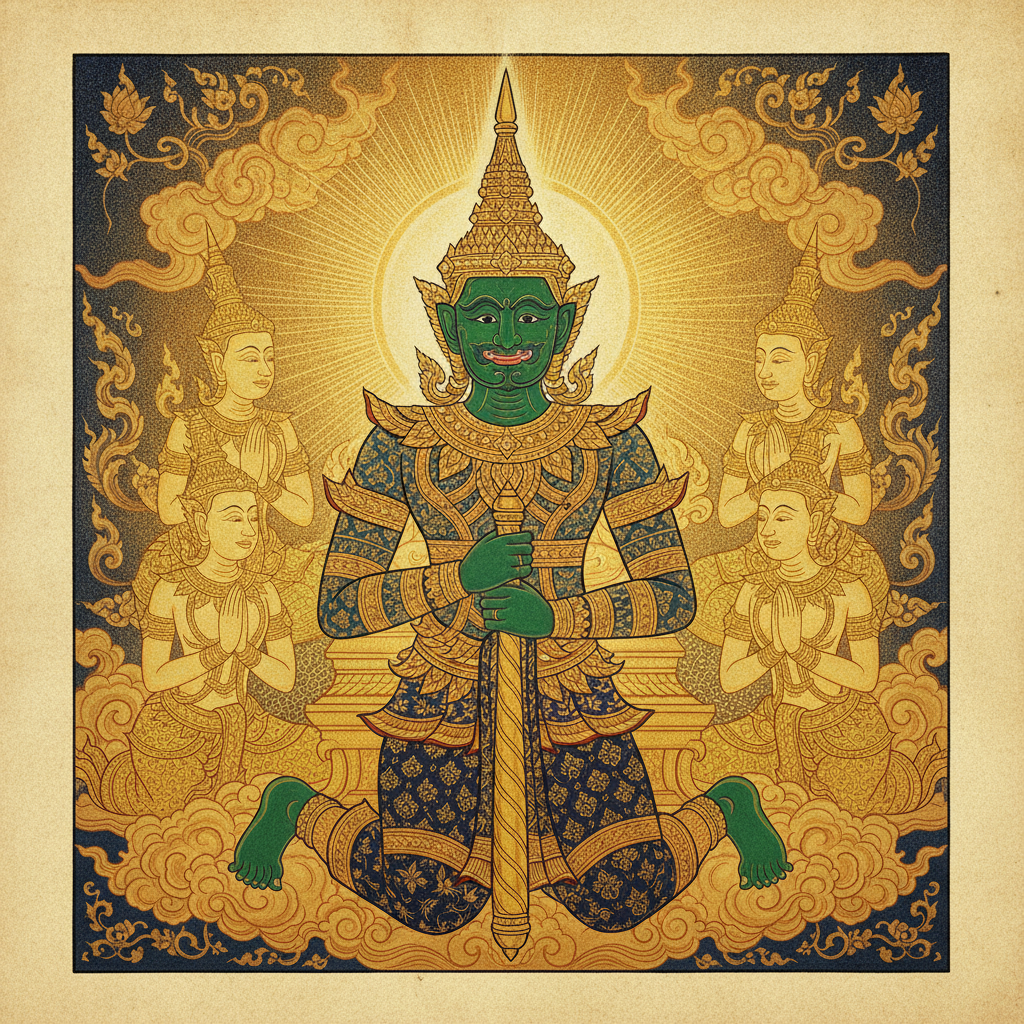
Why Is the Figure of Thao Wessuwon Usually Depicted as a Giant Holding a Club?
This appearance directly reflects his role in the legend. The club is a weapon symbolizing the authority of a great giant who commands his retinue, while the giant form reflects his role as ruler over all yakshas. Meanwhile, the Hindu tradition also depicts Kubera with a form that signifies wealth and power. The form seen in Thailand is thus a synthesis of the imageries from both traditions.
The legend of Thao Wessuwon is a good example of how multiple belief systems have merged in Thai culture. Both the Buddhist understanding from the Pali Canon and the Brahmanical-Hindu understanding from the epics complement each other, transforming into a deity whom people revere faithfully to this day. If you wish to know which deity suits your fortune best, or which day would be most auspicious for visiting a shrine, try our tools.
Ask our assistant which deity suits your fortune · Auspicious calendar that suggests the right day to worship · Auspicious wallpaper of Thao Wessuwon
References
- Wikipedia Thai: Thao Wessuwon — https://th.wikipedia.org/wiki/ท้าวเวสสุวรรณ
- Wikipedia: Vaiśravaṇa — https://en.wikipedia.org/wiki/Vaiśravaṇa
- Wikipedia: Kubera — https://en.wikipedia.org/wiki/Kubera
- Information on places and popular blessing requests — https://www.wongnai.com/articles/thao-wessuwan-temple-thailand
- Information on Wat Phra Sri Rattana Mahadhatu Rachworamahaviharn (Wat Yai), Phitsanulok — https://www.ktc.co.th/article/travel-stories/thailand/th/phitsanulok-refreshing-journey
- Atanata Sutta, Digha Nikaya, Silakkhandha-vagga (Pali Canon)
- Ramayana (Sanskrit original)